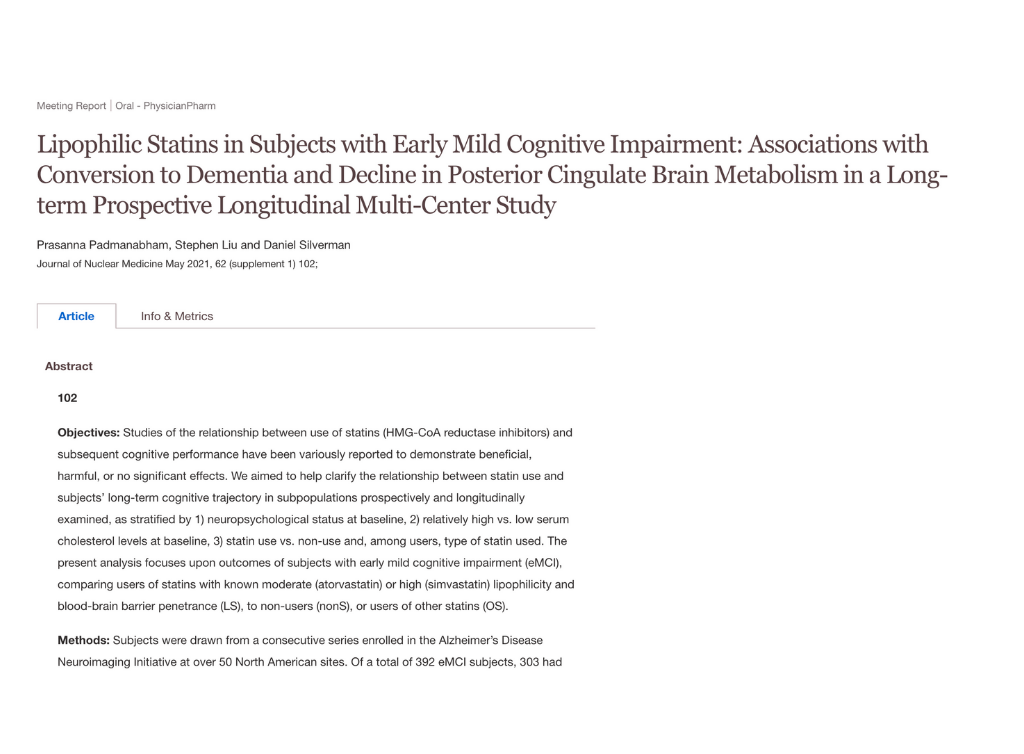
Article Review – Lipophilic Statins in Subjects with Early Mild Cognitive Impairment: Associations with Conversion to Dementia and Decline in Posterior Cingulate Brain Metabolism in a Long-term Prospective Longitudinal Multi-Center Study

Article Review – Lipophilic Statins in Subjects with Early Mild Cognitive Impairment: Associations with Conversion to Dementia and Decline in Posterior Cingulate Brain Metabolism in a Long-term Prospective Longitudinal Multi-Center Study

by Prasanna Padmanabham, Stephen Liu and Daniel Silverman

This article is part of Opti Metabolics’ ongoing effort to translate complex metabolic research into clear, practical insights for readers without formal scientific or medical training.

Summary -

This study finds that lipophilic statins, which penetrate the blood-brain barrier, are linked to a higher risk of dementia and accelerated metabolic decline in the posterior cingulate cortex among individuals with early mild cognitive impairment (eMCI) and low-to-moderate cholesterol levels. These findings suggest that lipophilic statins may exacerbate neurodegenerative processes in specific populations, raising concerns about their impact on brain metabolism and cognitive health. This has implications for personalized metabolic health strategies, emphasizing the need to balance cardiovascular benefits with potential neurological risks.

Key Takeaways Explained for a Non-Medical Audience

– The study examined 392 subjects with eMCI from the Alzheimer’s Disease Neuroimaging Initiative, focusing on statin use and cognitive outcomes over eight years.

– Subjects were grouped by baseline cholesterol levels (above or below the median of 206 mg/dl) and statin type (lipophilic, hydrophilic, or none).

– Lipophilic statins (e.g., atorvastatin, simvastatin) were associated with a 24% dementia conversion rate in eMCI subjects with below-median cholesterol, compared to 10% for non-statin users.

– The difference in dementia conversion rates was statistically significant for lipophilic statin users (p=0.04) but not for other statin users (p=0.94).

– Positron emission tomography (PET) scans showed significant metabolic decline in the posterior cingulate cortex among lipophilic statin users (p<0.0005).

– The posterior cingulate cortex is a brain region affected early in Alzheimer’s disease, suggesting a link to neurodegenerative progression.

– No significant metabolic decline was observed in non-statin users or those using hydrophilic statins.

– Among eMCI subjects with low cholesterol, lipophilic statin use tripled the risk of dementia over eight years compared to non-users.

– Baseline cholesterol levels did not differ significantly between those who converted to dementia (166 mg/dl) and those who did not (171 mg/dl).

– The study used statistical parametric mapping and standardized volume of interest analyses to confirm metabolic decline in the posterior cingulate cortex.

– Lipophilic statins’ ability to cross the blood-brain barrier may contribute to their impact on brain metabolism.

– The study suggests that lipophilic statins may not provide cognitive benefits in eMCI patients with low cholesterol and could pose risks.

– Functional connectivity in medial temporal regions was altered in lipophilic statin users, indicating broader neurological impacts.

– The findings highlight the need for careful consideration of statin type in patients with eMCI and low cholesterol levels.


Integrated Insights –

The study’s findings align with Opti Metabolics’ focus on personalized metabolic health, as lipophilic statins may disrupt brain cholesterol homeostasis, potentially exacerbating insulin resistance and inflammation-driven neurodegeneration. This underscores the importance of tailoring interventions to individual metabolic profiles, prioritizing natural dietary approaches like low-carbohydrate or ketogenic diets to support cognitive health. These strategies may mitigate risks associated with lipophilic statins by reducing metabolic stress and inflammation.

Alignment with Broader Review Content –

– The study’s observation of lipophilic statins’ impact on brain metabolism supports concerns about chronic inflammatory stresses, which can impair neuronal function and contribute to Alzheimer’s disease.

– The lack of cognitive benefit from lipophilic statins in low-cholesterol eMCI patients aligns with the need to address underlying metabolic contributors, such as insulin resistance, rather than relying solely on pharmacological interventions.

– The findings suggest that lifestyle interventions, such as low-carb or ketogenic diets, could be explored to support brain health and reduce reliance on medications with potential neurotoxic effects.

Reviewed and interpreted by the Opti Metabolics editorial team, with a focus on early metabolic risk detection and prevention.

Read the article to learn more: Lipophilic Statins in Subjects with Early Mild Cognitive Impairment: Associations with Conversion to Dementia and Decline in Posterior Cingulate Brain Metabolism in a Long-term Prospective Longitudinal Multi-Center Study

Health & Medical Disclaimer –

Opti Metabolics does not provide medical diagnosis, treatment, or advice. Our program is for educational and informational purposes only and does not represent medical advice or the practice of medicine. These article summaries are intended to help readers understand metabolic health research and emerging scientific findings, but personal health decisions should always be made in consultation with a qualified healthcare provider.

Participants are strongly advised to consult their personal healthcare professional before making any dietary, lifestyle, or medication changes.

x
Opti Metabolics provides informational health insights and does not dispense medical advice, diagnose, treat, or cure any medical conditions. Always consult a qualified healthcare professional before making any health-related decisions.

Contact With Us!

Email: info@optimetabolics.com

Join Opti Metabolics

It’s time to take control of your health.

Eat Like a Human Again

Drop your name and email to receive the eBook that shows how returning to simple, whole foods can restore stable energy, support metabolic health, and help your body function the way it was designed to.
Name

The Fast Track to Frailty

Drop your name and email to receive the guide that helps you understand how GLP-1 weight loss changes your body, and why the scale alone never tells the full story.
Name

Starving for Nothing

Drop your name and email to receive the eBook that shows why “Eat Less, Move More” was never your fault. It was the wrong story, and now you get the right one.
Name