Email: success@optimetabolics.com
This article is part of Opti Metabolics’ ongoing effort to translate complex metabolic research into clear, practical insights for readers without formal scientific or medical training.
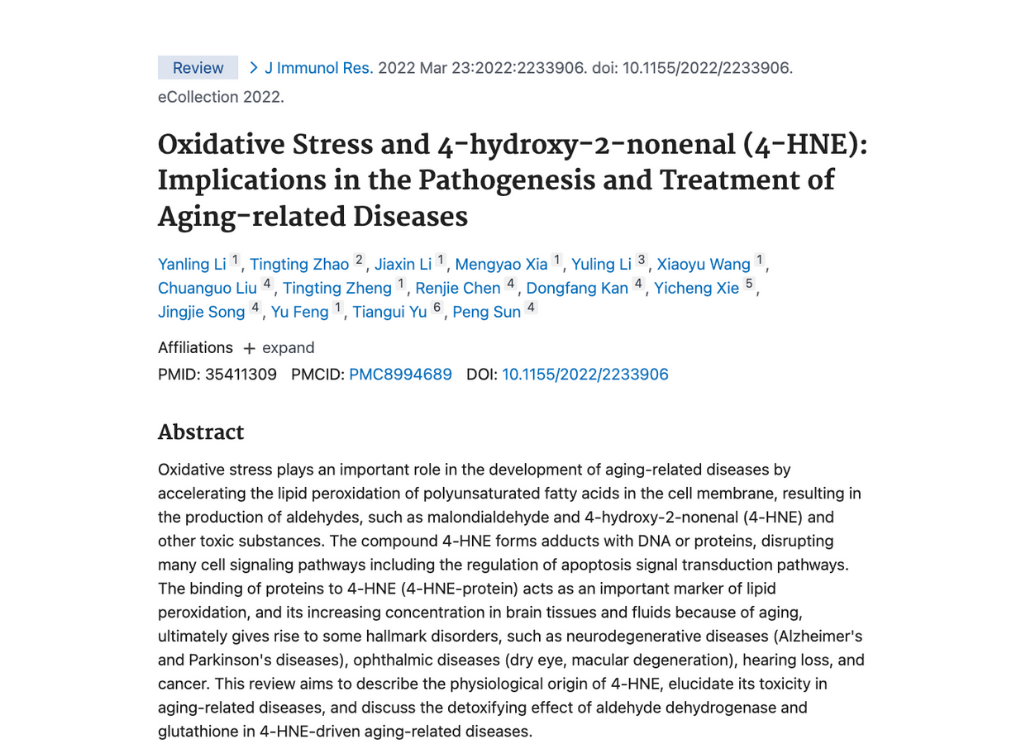
This article explores the role of oxidative stress and 4-hydroxy-2-nonenal (4-HNE), a toxic byproduct of lipid peroxidation, in driving aging-related diseases like Alzheimer’s, Parkinson’s, cancer, and ophthalmic disorders, emphasizing its disruption of cellular signaling and the potential of aldehyde dehydrogenase (ALDH) and glutathione (GSH) as detoxifying agents. It highlights how excessive omega-6 fatty acid peroxidation contributes to 4-HNE accumulation, exacerbating metabolic stress and chronic disease. Addressing these pathways through targeted antioxidant strategies and dietary interventions may mitigate disease progression and improve metabolic health.
– Oxidative stress accelerates lipid peroxidation of omega-6 polyunsaturated fatty acids, producing toxic aldehydes like 4-HNE and malondialdehyde (MDA).
– 4-HNE forms adducts with DNA and proteins, disrupting cell signaling pathways, including apoptosis regulation, contributing to disease pathogenesis.
– In Alzheimer’s disease, 4-HNE induces protein aggregation and tau hyperphosphorylation, leading to amyloid plaques and neurofibrillary tangles.
– In Parkinson’s disease, 4-HNE promotes α-synuclein aggregation, forming Lewy body-like inclusions and neuronal damage.
– 4-HNE contributes to cancer by causing DNA damage and activating the KEAP1/Nrf2 pathway, influencing antioxidant gene expression and tumor progression.
– In age-related macular degeneration, 4-HNE activates pathways like NF-κB and p53, inducing retinal pigment epithelium apoptosis.
– Age-related hearing loss is linked to 4-HNE-induced DNA damage and altered activity of proteins like p21 and p38.
– 4-HNE concentrations below 2 μM may promote cell survival, while higher levels are toxic, highlighting a dose-dependent effect.
– Aldehyde dehydrogenase (ALDH) oxidizes 4-HNE into less harmful compounds, reducing its toxicity in cells.
– Glutathione (GSH) conjugates with 4-HNE, aiding its detoxification and mitigating oxidative damage.
– Studies in Parkinson’s disease models show that impaired ALDH function increases 4-HNE levels, worsening motor deficits and neuronal loss.
– 4-HNE upregulates proinflammatory cytokines like TNF-α and TGF-β1 via NF-κB, contributing to chronic inflammation.
– Lipid peroxidation, driven by reactive oxygen species (ROS), is a key mechanism in the formation of 4-HNE and other toxic aldehydes.
– The brain’s high omega-6 fatty acid content and oxygen consumption make it particularly susceptible to 4-HNE-mediated damage.
– Therapeutic strategies targeting ALDH and GSH could reduce 4-HNE toxicity and improve outcomes in aging-related diseases.
The article underscores the link between omega-6 fatty acid peroxidation, 4-HNE accumulation, and metabolic dysfunction, aligning with Opti Metabolics’ focus on reducing inflammation and oxidative stress through dietary interventions like low-carbohydrate or ketogenic diets. By limiting omega-6-rich seed oils and enhancing antioxidant defenses, such as GSH, these strategies could mitigate 4-HNE-driven damage and support metabolic health. This framework supports the article’s call for exploring ALDH and GSH as therapeutic targets to address chronic disease.
– The article’s emphasis on omega-6 fatty acid peroxidation as a source of 4-HNE aligns with Opti Metabolics’ view that seed oils exacerbate inflammation and metabolic stress, contributing to chronic diseases.
– The role of 4-HNE in insulin resistance-related conditions like Alzheimer’s and cancer supports the principle that metabolic dysfunction, driven by poor dietary choices, underlies many chronic diseases.
– The potential of ALDH and GSH to detoxify 4-HNE complements the advocacy for natural, antioxidant-rich interventions to restore metabolic balance and reduce disease risk.
Reviewed and interpreted by the Opti Metabolics editorial team, with a focus on early metabolic risk detection and prevention.
Read the article to learn more: Oxidative Stress and 4-hydroxy-2-nonenal (4-HNE): Implications in the Pathogenesis and Treatment of Aging-related Diseases
Opti Metabolics does not provide medical diagnosis, treatment, or advice. Our program is for educational and informational purposes only and does not represent medical advice or the practice of medicine. These article summaries are intended to help readers understand metabolic health research and emerging scientific findings, but personal health decisions should always be made in consultation with a qualified healthcare provider.
Participants are strongly advised to consult their personal healthcare professional before making any dietary, lifestyle, or medication changes.
Email: info@optimetabolics.com
It’s time to take control of your health.