Article Review – Restoration of Mitochondria Function as a Target for Cancer Therapy

Article Review – Restoration of Mitochondria Function as a Target for Cancer Therapy

by Tariq A Bhat, Sandeep Kumar, Ajay K Chaudhary, Neelu Yadav, Dhyan Chandra

This article is part of Opti Metabolics’ ongoing effort to translate complex metabolic research into clear, practical insights for readers without formal scientific or medical training.

Summary -

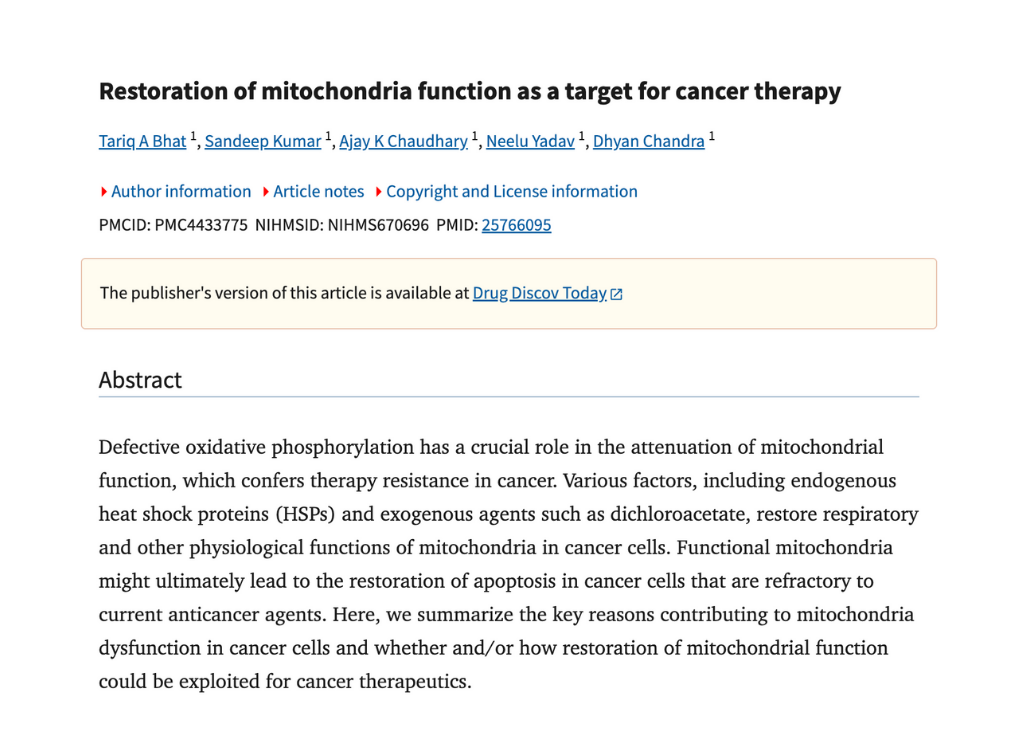
This article explores how defective mitochondrial function, particularly impaired oxidative phosphorylation, contributes to cancer therapy resistance, and how restoring mitochondrial function using agents like dichloroacetate and heat shock proteins can induce apoptosis in cancer cells. It highlights the potential of targeting mitochondrial metabolism to overcome resistance to conventional cancer treatments, aligning with metabolic health strategies that emphasize cellular energy regulation. These findings suggest that enhancing mitochondrial function could be a novel approach to improve cancer outcomes while addressing underlying metabolic dysfunctions.

Key Takeaways Explained for a Non-Medical Audience

– Mitochondrial dysfunction, particularly defective oxidative phosphorylation, is a key factor in cancer cells’ resistance to therapy.  

– Impaired mitochondrial function reduces apoptosis, allowing cancer cells to survive treatments that would typically induce programmed cell death.  

– Endogenous heat shock proteins (HSPs) play a role in restoring mitochondrial respiratory and physiological functions in cancer cells.  

– Exogenous agents like dichloroacetate (DCA) can enhance mitochondrial function by promoting oxidative metabolism over glycolysis.  

– Restoring mitochondrial function can re-sensitize cancer cells to apoptosis, improving the efficacy of anticancer therapies.  

– The Warburg effect, where cancer cells favor glycolysis over oxidative phosphorylation, contributes to therapy resistance.  

– Dichloroacetate inhibits pyruvate dehydrogenase kinase, shifting cancer cell metabolism toward mitochondrial respiration.  

– Functional mitochondria are critical for activating caspase-dependent apoptosis pathways in cancer cells.  

– Mitochondrial DNA mutations and altered gene expression are linked to cancer progression and therapy resistance.  

– Targeting mitochondrial metabolism offers a novel therapeutic strategy to overcome resistance in various cancers, including breast and prostate.  

– Combining mitochondrial-targeted therapies with existing treatments may enhance overall cancer treatment outcomes.  

– The article emphasizes the role of mitochondrial bioenergetics in regulating cancer cell survival and proliferation.  

– Agents that restore mitochondrial function could reduce the reliance on glycolysis, disrupting the Warburg phenotype in cancer cells. 

Integrated Insights –

The article’s focus on restoring mitochondrial function aligns with the Opti Metabolics framework, which emphasizes optimizing cellular energy metabolism to improve health outcomes. By addressing mitochondrial dysfunction, therapies like dichloroacetate may mitigate metabolic stress and inflammation, key contributors to cancer progression and insulin resistance. This approach supports the use of low-carbohydrate or ketogenic diets to reduce glucose availability, potentially starving cancer cells while enhancing mitochondrial efficiency.

Alignment with Broader Review Content –

– The emphasis on mitochondrial metabolism connects to the Opti Metabolics principle that cellular energy regulation is central to preventing chronic diseases, including cancer.  

– The article’s findings on reducing glycolysis through mitochondrial restoration align with low-carbohydrate dietary strategies that limit glucose-driven metabolic stress.  

– Targeting inflammation and oxidative stress via mitochondrial function supports the broader goal of reducing chronic inflammatory stresses linked to insulin resistance and cancer.

Reviewed and interpreted by the Opti Metabolics editorial team, with a focus on early metabolic risk detection and prevention.

Read the article to learn more: Restoration of Mitochondria Function as a Target for Cancer Therapy

Health & Medical Disclaimer –

Opti Metabolics does not provide medical diagnosis, treatment, or advice. Our program is for educational and informational purposes only and does not represent medical advice or the practice of medicine. These article summaries are intended to help readers understand metabolic health research and emerging scientific findings, but personal health decisions should always be made in consultation with a qualified healthcare provider.

Participants are strongly advised to consult their personal healthcare professional before making any dietary, lifestyle, or medication changes.

x
Opti Metabolics provides informational health insights and does not dispense medical advice, diagnose, treat, or cure any medical conditions. Always consult a qualified healthcare professional before making any health-related decisions.

Contact With Us!

Email: info@optimetabolics.com

Join Opti Metabolics

It’s time to take control of your health.

Eat Like a Human Again

Drop your name and email to receive the eBook that shows how returning to simple, whole foods can restore stable energy, support metabolic health, and help your body function the way it was designed to.
Name

The Fast Track to Frailty

Drop your name and email to receive the guide that helps you understand how GLP-1 weight loss changes your body, and why the scale alone never tells the full story.
Name

Starving for Nothing

Drop your name and email to receive the eBook that shows why “Eat Less, Move More” was never your fault. It was the wrong story, and now you get the right one.
Name