Article Review – Insulin Resistance

Article Review – Insulin Resistance

by Andrew M. Freeman, Luis A. Acevedo, Nicholas Pennings

This article is part of Opti Metabolics’ ongoing effort to translate complex metabolic research into clear, practical insights for readers without formal scientific or medical training.

Summary -

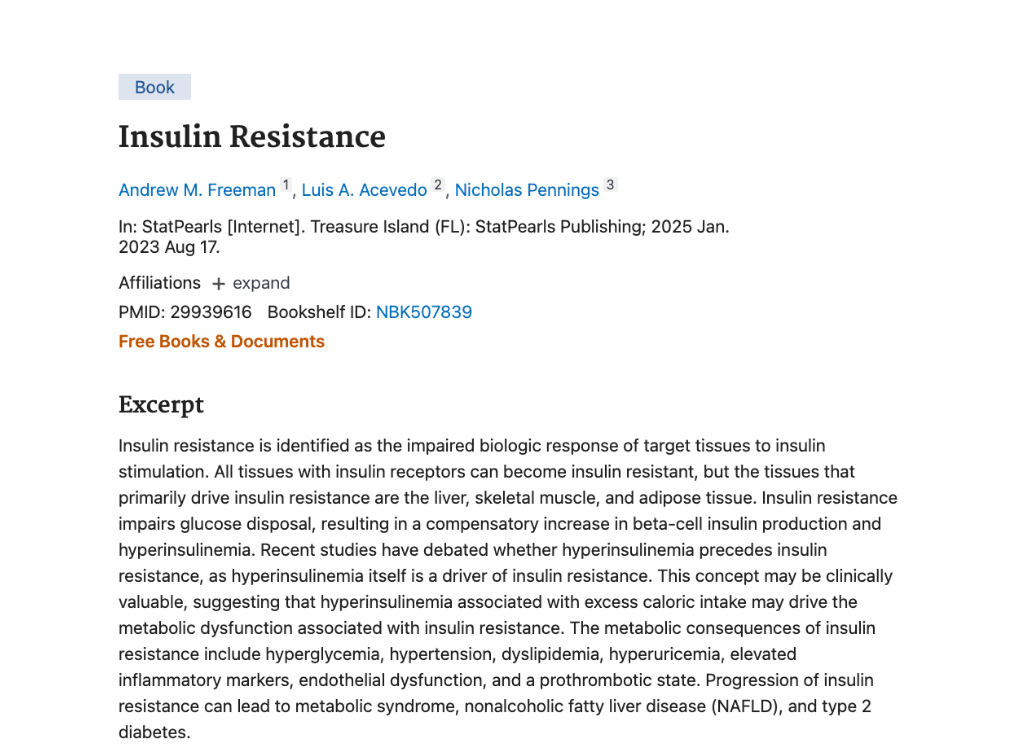
This educational review defines insulin resistance as an impaired biologic response of target tissues—primarily the liver, muscle, and adipose tissue—to insulin stimulation, often resulting in compensatory hyperinsulinemia. It underscores the extensive metabolic and cardiovascular complications that can develop over a decade or more before the onset of overt type 2 diabetes.

Key Takeaways Explained for a Non-Medical Audience

– Insulin resistance impairs glucose disposal in key tissues, prompting compensatory hyperinsulinemia in response.

– Hyperinsulinemia itself may precede and worsen insulin resistance by promoting metabolic dysfunction.

– Common consequences include hyperglycemia, hypertension, dyslipidemia, hyperuricemia, elevated inflammatory markers, endothelial dysfunction, and a prothrombotic state.

– Insulin resistance often develops 10 to 15 years before the clinical onset of type 2 diabetes.

– The condition contributes to metabolic syndrome, nonalcoholic fatty liver disease, and cardiovascular disease.

– Obesity—especially excess adiposity—is a primary acquired driver, though genetic predisposition also plays a role.

– Gold standard testing like the hyperinsulinemic‑euglycemic clamp is impractical; surrogate measures include HOMA‑IR, QUICKI, triglyceride‑to‑HDL ratio, and other indices.

– Insulin resistance increases risk for microvascular (neuropathy, retinopathy, nephropathy) and macrovascular (coronary, cerebrovascular, peripheral artery disease) complications.

– Lifestyle modification is the first-line intervention, emphasizing reduced caloric intake and avoidance of carbohydrates that drive excessive insulin demand.

– Physical activity enhances energy expenditure and improves insulin sensitivity in skeletal muscle.

– Medications may reduce insulin demand or improve insulin response, but are secondary to lifestyle.

– Interprofessional care coordination enhances management and reduces progression of complications.

– Early detection and proactive management are essential to prevent long-term metabolic and vascular damage.


Integrated Insights –

This review closely aligns with the Opti Metabolics model by asserting that insulin resistance is a root cause of metabolic and vascular disease and highlighting that hyperinsulinemia is both a symptom and driver. It reinforces our strategy of targeting insulin demand through carbohydrate reduction, inflammation modulation, and nutrient-dense, low-inflammatory dietary patterns.

Alignment with Broader Review Content –

– The identified mechanistic cascade from insulin resistance to hyperinsulinemia, inflammation, endothelial dysfunction, and vascular disease supports our imperative approach to carbohydrate moderation and metabolic reset.

– The 10–15 year development window before diabetes encourages early intervention—a cornerstone of the Opti Metabolics philosophy.

– Lifestyle-first treatment emphasizing nutrient quality and carbohydrate selection mirrors our framework’s emphasis on the Purple Zone of metabolic resilience and prevention.

Reviewed and interpreted by the Opti Metabolics editorial team, with a focus on early metabolic risk detection and prevention.

Read the article to learn more: Insulin Resistance

Health & Medical Disclaimer –

Opti Metabolics does not provide medical diagnosis, treatment, or advice. Our program is for educational and informational purposes only and does not represent medical advice or the practice of medicine. These article summaries are intended to help readers understand metabolic health research and emerging scientific findings, but personal health decisions should always be made in consultation with a qualified healthcare provider.

Participants are strongly advised to consult their personal healthcare professional before making any dietary, lifestyle, or medication changes.

x
Opti Metabolics provides informational health insights and does not dispense medical advice, diagnose, treat, or cure any medical conditions. Always consult a qualified healthcare professional before making any health-related decisions.

Contact With Us!

Email: info@optimetabolics.com

Join Opti Metabolics

It’s time to take control of your health.

Eat Like a Human Again

Drop your name and email to receive the eBook that shows how returning to simple, whole foods can restore stable energy, support metabolic health, and help your body function the way it was designed to.
Name

The Fast Track to Frailty

Drop your name and email to receive the guide that helps you understand how GLP-1 weight loss changes your body, and why the scale alone never tells the full story.
Name

Starving for Nothing

Drop your name and email to receive the eBook that shows why “Eat Less, Move More” was never your fault. It was the wrong story, and now you get the right one.
Name