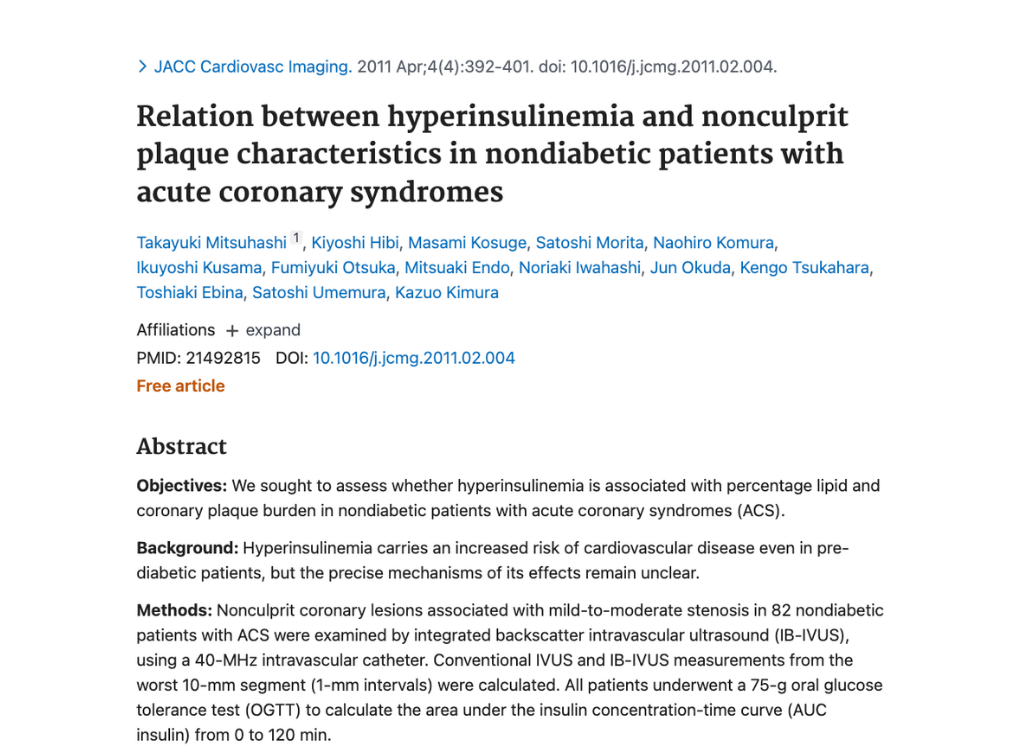
Article Review – Relation Between Hyperinsulinemia and Nonculprit Plaque Characteristics in Nondiabetic Patients With Acute Coronary Syndromes

Article Review – Relation Between Hyperinsulinemia and Nonculprit Plaque Characteristics in Nondiabetic Patients With Acute Coronary Syndromes

by Takayuki Mitsuhashi MD, Kiyoshi Hibi MD, Masami Kosuge MD, Satoshi Morita PhD, Naohiro Komura MD, Ikuyoshi Kusama MD, Fumiyuki Otsuka MD, Mitsuaki Endo MD, Noriaki Iwahashi MD, Jun Okuda MD, Kengo Tsukahara MD, Toshiaki Ebina MD, Satoshi Umemura MD, Kazuo Kimura MD

This article is part of Opti Metabolics’ ongoing effort to translate complex metabolic research into clear, practical insights for readers without formal scientific or medical training.

Summary -

This study reveals that hyperinsulinemia, even in nondiabetic individuals, is strongly associated with more vulnerable coronary artery plaque features, contributing to an increased risk of acute coronary events. The findings underscore insulin’s pathological role in cardiovascular disease and reinforce the importance of early metabolic intervention in patients without overt diabetes.

Key Takeaways Explained for a Non-Medical Audience

– Elevated fasting insulin levels in nondiabetic patients were linked to more unstable, high-risk coronary plaques.

– Hyperinsulinemia was associated with greater plaque burden and the presence of thin-cap fibroatheromas, a marker of vulnerability to rupture.

– Patients with hyperinsulinemia showed higher total plaque volume and more noncalcified plaque components.

– The relationship between hyperinsulinemia and plaque vulnerability was independent of other cardiovascular risk factors like LDL cholesterol or BMI.

– This study highlights that metabolic dysfunction can precede overt hyperglycemia and still contribute to cardiovascular pathology.

– Insulin itself may exert direct atherogenic effects on vascular smooth muscle cells and endothelial function.

– Chronic exposure to elevated insulin can trigger inflammatory signaling pathways in vascular tissue.

– Increased insulin levels may promote lipid uptake into plaques, enhancing their growth and instability.

– These findings suggest that insulin is not merely a marker, but a mechanistic driver of coronary artery disease progression.

– Hyperinsulinemia may be a silent but modifiable risk factor in patients who appear otherwise low-risk by traditional assessments.

– Diagnostic strategies focusing solely on glucose or HbA1c may miss early and significant cardiovascular risk from hyperinsulinemia.

– Early identification of insulin dysregulation allows for interventions before the onset of diabetes or major cardiac events.

– Lifestyle and dietary measures that lower insulin can reduce the development and destabilization of atherosclerotic plaques.

– Coronary CT imaging combined with insulin profiling could enhance risk stratification in acute coronary syndrome patients.


Integrated Insights –

This study reinforces the Opti Metabolics emphasis on hyperinsulinemia as a critical root cause of cardiovascular pathology, even in the absence of diabetes. Early identification and correction of elevated insulin levels through low-carbohydrate, anti-inflammatory strategies can play a preventive role in halting atherosclerotic progression.

Alignment with Broader Review Content –

– The association between hyperinsulinemia and plaque vulnerability supports our model of insulin as a pro-atherogenic hormone, not merely a blood sugar regulator.

– The independent nature of insulin’s cardiovascular effects strengthens the case for early metabolic screening, even when glucose markers appear normal.

– These findings further validate the importance of carbohydrate restriction and inflammatory load reduction as central to cardiovascular disease prevention.

Reviewed and interpreted by the Opti Metabolics editorial team, with a focus on early metabolic risk detection and prevention.

Read the article to learn more: Relation Between Hyperinsulinemia and Nonculprit Plaque Characteristics in Nondiabetic Patients With Acute Coronary Syndromes

Health & Medical Disclaimer –

Opti Metabolics does not provide medical diagnosis, treatment, or advice. Our program is for educational and informational purposes only and does not represent medical advice or the practice of medicine. These article summaries are intended to help readers understand metabolic health research and emerging scientific findings, but personal health decisions should always be made in consultation with a qualified healthcare provider.

Participants are strongly advised to consult their personal healthcare professional before making any dietary, lifestyle, or medication changes.

x
Opti Metabolics provides informational health insights and does not dispense medical advice, diagnose, treat, or cure any medical conditions. Always consult a qualified healthcare professional before making any health-related decisions.

Contact With Us!

Email: info@optimetabolics.com

Join Opti Metabolics

It’s time to take control of your health.

Eat Like a Human Again

Drop your name and email to receive the eBook that shows how returning to simple, whole foods can restore stable energy, support metabolic health, and help your body function the way it was designed to.
Name

The Fast Track to Frailty

Drop your name and email to receive the guide that helps you understand how GLP-1 weight loss changes your body, and why the scale alone never tells the full story.
Name

Starving for Nothing

Drop your name and email to receive the eBook that shows why “Eat Less, Move More” was never your fault. It was the wrong story, and now you get the right one.
Name