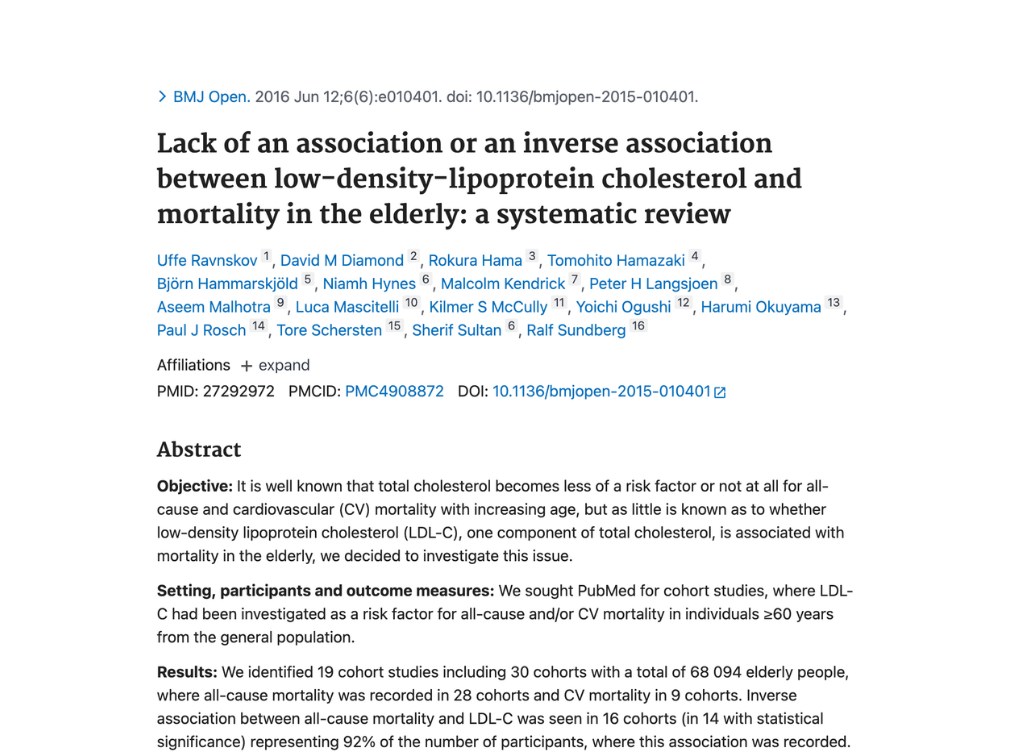
Article Review – Lack of an Association or an Inverse Association between Low-Density-Lipoprotein Cholesterol and Mortality in the Elderly: A Systematic Review

Article Review – Lack of an Association or an Inverse Association between Low-Density-Lipoprotein Cholesterol and Mortality in the Elderly: A Systematic Review

by Uffe Ravnskov, David M Diamond, Rokura Hama, Tomohito Hamazaki, Björn Hammarskjöld, Niamh Hynes, Malcolm Kendrick, Peter H Langsjoen, Aseem Malhotra, Luca Mascitelli, Kilmer S McCully, Yoichi Ogushi, Harumi Okuyama, Paul J Rosch, Tore Schersten, Sherif Sultan, Ralf Sundberg

This article is part of Opti Metabolics’ ongoing effort to translate complex metabolic research into clear, practical insights for readers without formal scientific or medical training.

Summary -

This systematic review challenges the conventional view that high low-density-lipoprotein cholesterol (LDL-C) is a primary driver of mortality in the elderly, finding no consistent association or even an inverse relationship between LDL-C levels and all-cause mortality. These findings question the overemphasis on lowering LDL-C through dietary interventions or medications and suggest that metabolic health strategies should prioritize insulin sensitivity and inflammation reduction over cholesterol management.

Key Takeaways Explained for a Non-Medical Audience

– The systematic review analyzed 19 studies focusing on LDL-C levels and mortality in individuals aged 60 and older.

– No consistent positive association was found between LDL-C levels and all-cause mortality in the elderly.

– Several studies reported an inverse association, where higher LDL-C levels were linked to lower mortality risk.

– The review included cohort studies with a total of over 68,000 participants, primarily from community settings.

– Higher LDL-C levels were associated with increased longevity in some elderly populations, particularly those over 80.

– The traditional lipid hypothesis, linking high LDL-C to cardiovascular disease and mortality, is questioned by these findings.

– LDL-C may play a protective role in the elderly, potentially supporting immune function and reducing infection risk.

– The review highlights the potential harm of aggressive LDL-C-lowering interventions, such as statins, in older adults.

– Studies showed no significant link between LDL-C and cardiovascular mortality in elderly populations.

– The authors argue that the focus on LDL-C reduction may overlook other metabolic factors like insulin resistance.

– Inflammation and oxidative stress are suggested as more critical drivers of mortality than LDL-C in the elderly.

– The review critiques the reliance on LDL-C as a primary risk factor in dietary and pharmacological guidelines.

– Some studies indicated that low LDL-C levels were associated with higher risks of cancer and infectious diseases.

– The findings suggest a need to re-evaluate cholesterol-lowering strategies in the context of overall metabolic health.


Integrated Insights –

The findings align with the Opti Metabolics framework, which prioritizes addressing insulin resistance and chronic inflammation over conventional cholesterol-focused interventions. By questioning the role of LDL-C in elderly mortality, the review supports dietary approaches like low-carbohydrate or ketogenic diets that reduce metabolic stress and improve glycemic control. This shift emphasizes holistic metabolic health over isolated lipid markers.

Alignment with Broader Review Content –

– Challenges the conventional focus on LDL-C reduction, advocating for a broader view of metabolic health that includes insulin sensitivity and inflammation control.

– Supports the use of low-carb or ketogenic diets to mitigate insulin resistance and chronic inflammatory stresses, which are more relevant to mortality risk.

– Highlights the potential risks of omega-6-rich seed oils and high-carbohydrate diets, which may exacerbate metabolic dysfunction beyond LDL-C effects.

Reviewed and interpreted by the Opti Metabolics editorial team, with a focus on early metabolic risk detection and prevention.

Read the article to learn more: Lack of an Association or an Inverse Association between Low-Density-Lipoprotein Cholesterol and Mortality in the Elderly: A Systematic Review

Health & Medical Disclaimer –

Opti Metabolics does not provide medical diagnosis, treatment, or advice. Our program is for educational and informational purposes only and does not represent medical advice or the practice of medicine. These article summaries are intended to help readers understand metabolic health research and emerging scientific findings, but personal health decisions should always be made in consultation with a qualified healthcare provider.

Participants are strongly advised to consult their personal healthcare professional before making any dietary, lifestyle, or medication changes.

x
Opti Metabolics provides informational health insights and does not dispense medical advice, diagnose, treat, or cure any medical conditions. Always consult a qualified healthcare professional before making any health-related decisions.

Contact With Us!

Email: info@optimetabolics.com

Join Opti Metabolics

It’s time to take control of your health.

Eat Like a Human Again

Drop your name and email to receive the eBook that shows how returning to simple, whole foods can restore stable energy, support metabolic health, and help your body function the way it was designed to.
Name

The Fast Track to Frailty

Drop your name and email to receive the guide that helps you understand how GLP-1 weight loss changes your body, and why the scale alone never tells the full story.
Name

Starving for Nothing

Drop your name and email to receive the eBook that shows why “Eat Less, Move More” was never your fault. It was the wrong story, and now you get the right one.
Name