Email: success@optimetabolics.com
This article is part of Opti Metabolics’ ongoing effort to translate complex metabolic research into clear, practical insights for readers without formal scientific or medical training.
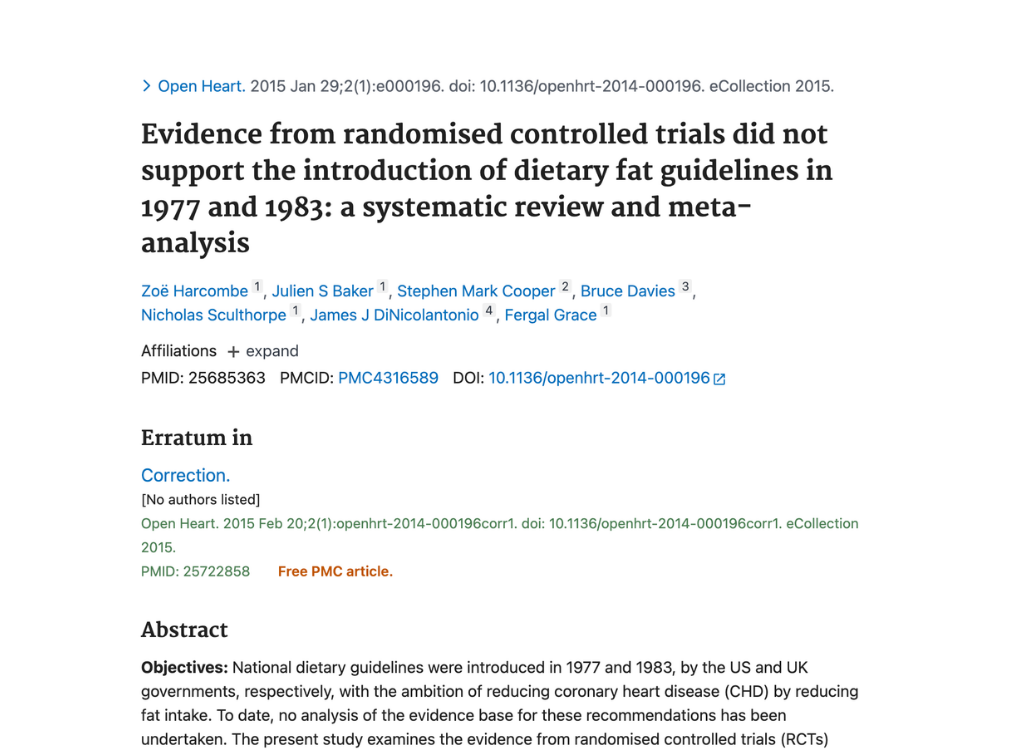
This systematic review and meta-analysis found no evidence from randomized controlled trials (RCTs) to support the US and UK dietary fat guidelines introduced in 1977 and 1983, which aimed to reduce coronary heart disease (CHD) by limiting fat intake. Despite significant reductions in serum cholesterol in intervention groups, there were no significant differences in CHD or all-cause mortality, challenging the basis for low-fat dietary recommendations. These findings suggest that historical dietary guidelines may have overlooked metabolic health factors, such as insulin resistance and inflammation, which are critical to chronic disease prevention.
– National dietary guidelines in the US (1977) and UK (1983) aimed to reduce CHD by limiting total fat to 30% and saturated fat to 10% of energy intake.
– The study analyzed six RCTs conducted before 1983, involving 2467 male participants, with five secondary prevention studies and one including healthy individuals.
– A total of 370 deaths from all-cause mortality were recorded across intervention and control groups, with a risk ratio (RR) of 0.996 (95% CI 0.865 to 1.147).
– There were 207 CHD deaths in intervention groups and 216 in control groups, with an RR of 0.989 (95% CI 0.784 to 1.247), indicating no significant difference.
– Intervention groups showed significant reductions in mean serum cholesterol levels compared to control groups.
– Reduced cholesterol levels in intervention groups did not lead to significant differences in CHD or all-cause mortality.
– The RCTs were conducted exclusively on males, limiting the generalizability of findings to broader populations.
– No RCTs tested the specific dietary fat recommendations before their implementation in 1977 and 1983.
– The study followed PRISMA guidelines for systematic review and meta-analysis, ensuring methodological rigor.
– Inclusion criteria for RCTs required a minimum duration of one year and data on all-cause mortality, CHD mortality, and cholesterol measurements.
– Exclusion criteria eliminated observational, non-randomized, or multifactorial studies to focus on dietary fat interventions.
– The findings challenge the assumption that lowering dietary fat inherently reduces CHD risk.
– The authors suggest that dietary guidelines may have been introduced without sufficient evidence, impacting 220 million US and 56 million UK citizens by 1983.
– The lack of evidence supporting fat restriction calls for a re-evaluation of dietary recommendations.
– The study highlights the need for dietary guidelines to consider broader metabolic impacts beyond cholesterol levels.
The article aligns with the Opti Metabolics framework by questioning low-fat dietary guidelines that may exacerbate insulin resistance and inflammation, key drivers of metabolic dysfunction. It underscores the importance of evidence-based nutrition strategies, such as low-carbohydrate or ketogenic diets, which prioritize metabolic health over outdated cholesterol-focused recommendations. These findings support a shift toward personalized, whole-food-based dietary approaches to mitigate chronic disease risk.
– The lack of RCT evidence for low-fat guidelines aligns with Opti Metabolics’ emphasis on addressing insulin resistance, which is often worsened by high-carbohydrate diets promoted as alternatives to fats.
– The study’s focus on CHD outcomes connects to the broader metabolic health framework, highlighting how inflammation and metabolic stress, potentially driven by omega-6-rich diets, contribute to chronic diseases.
– The call for re-evaluating dietary guidelines supports the Purple Zone principle of critically examining establishment narratives to prioritize scientifically grounded, individualized health strategies.
Reviewed and interpreted by the Opti Metabolics editorial team, with a focus on early metabolic risk detection and prevention.
Read the article to learn more: Evidence from Randomised Controlled Trials Did Not Support the Introduction of Dietary Fat Guidelines in 1977 and 1983: A Systematic Review and Meta-Analysis
Opti Metabolics does not provide medical diagnosis, treatment, or advice. Our program is for educational and informational purposes only and does not represent medical advice or the practice of medicine. These article summaries are intended to help readers understand metabolic health research and emerging scientific findings, but personal health decisions should always be made in consultation with a qualified healthcare provider.
Participants are strongly advised to consult their personal healthcare professional before making any dietary, lifestyle, or medication changes.
Email: info@optimetabolics.com
It’s time to take control of your health.