Article Review – Cholesterol: What the American Heart Association is Hiding from You (Part 3)

Article Review – Cholesterol: What the American Heart Association is Hiding from You (Part 3)

by Dr. Cate

This article is part of Opti Metabolics’ ongoing effort to translate complex metabolic research into clear, practical insights for readers without formal scientific or medical training.

Summary -

The article exposes how the American Heart Association and Ancel Keys suppressed data on smoking’s role in heart disease to promote the flawed theory that saturated fats and cholesterol cause atherosclerosis, while pushing vegetable oils high in polyunsaturated fatty acids. This deception has led to widespread consumption of inflammatory seed oils, contributing to oxidative stress and metabolic dysfunction. By adopting a low-polyunsaturated fatty acid diet with natural, stable fats, individuals can mitigate inflammation, improve metabolic health, and reduce risks of chronic conditions like heart disease, aligning with principles of balanced energy management and inflammation control.

Key Takeaways Explained for a Non-Medical Audience

– The Seven Countries Study, led by Ancel Keys and supported by the American Heart Association, downplayed the strong correlation between smoking and heart attacks to focus on saturated fats.

– In the 1950s, the American Heart Association claimed more research was needed on smoking while aggressively linking saturated fat and cholesterol to heart disease without solid evidence.

– Ancel Keys published cherry-picked data from six countries in 1953 to show a correlation between fat intake and heart attacks, ignoring data from 16 other countries.

– By 1956, the American Heart Association urged dietary changes to reduce saturated fat, despite lacking comprehensive data on its risks.

– The 1961 American Heart Association dietary guidelines were based on incomplete Seven Countries Study results, asserting links between saturated fat, cholesterol, and heart attacks.

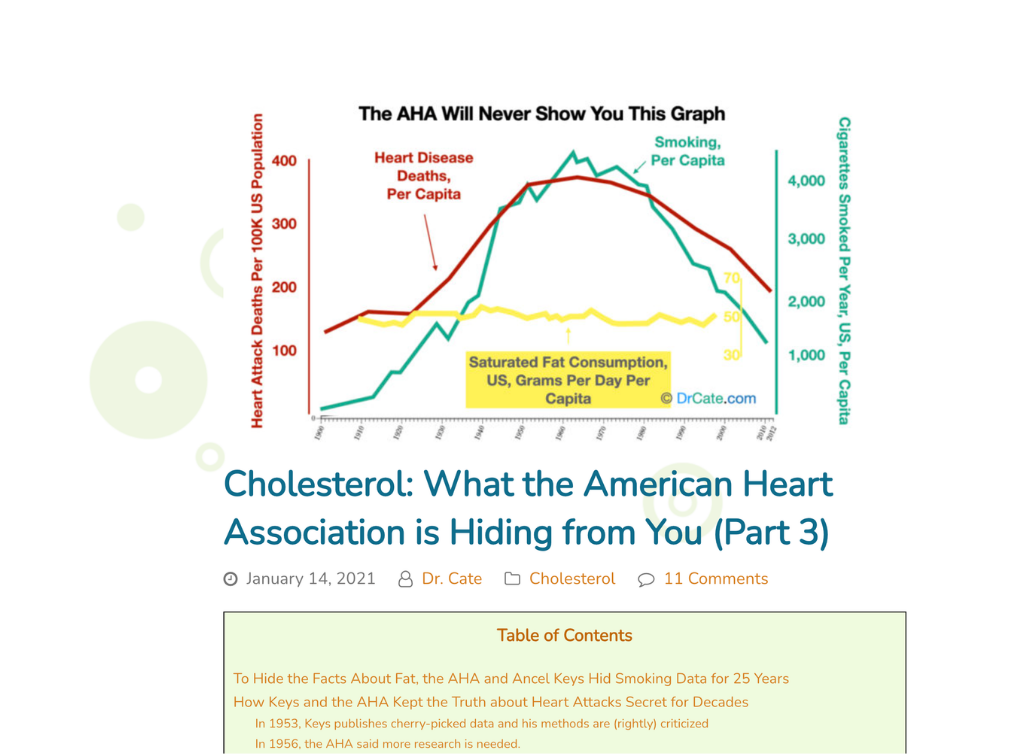
– Smoking data from the Seven Countries Study, showing a strong association with coronary heart disease mortality, was not published until at least 1980.

– In 1971, Keys concluded that smoking and weight were unimportant for heart attacks, contradicting earlier evidence.

– Cardiovascular disease deaths declined below 50 percent of all causes in 1981, coinciding with falling smoking rates rather than changes in saturated fat intake.

– The American Heart Association delayed significant anti-smoking policies until the 1980s, despite having data since the 1960s.

– Modern American Heart Association recommendations continue to promote vegetable oils like canola and soy, which are prone to oxidation and now constitute most fat calories in diets.

– The article argues that the cholesterol deception was intentional, driven by funding from vegetable oil companies and Keys’ ego.

– Confirmation bias or foul play in Keys’ work has perpetuated harmful dietary advice, putting patients at risk.

– Following a low-polyunsaturated fatty acid lifestyle eliminates the need to worry about cholesterol levels or heart attack risk.

– The author urges rejecting American Heart Association guidance in favor of diets based on whole-food fats as outlined in related books.


Integrated Insights –

This article aligns with the Opti Metabolics framework by highlighting how polyunsaturated fatty acid-rich seed oils promote oxidative stress and inflammation, exacerbating metabolic issues like insulin resistance. Emphasizing natural, stable fats supports the Purple Zone’s focus on balanced metabolic health through low-carbohydrate or ketogenic approaches. Overall, it reinforces the need to address root causes of chronic diseases via dietary shifts that prioritize metabolic optimization over flawed institutional advice.

Alignment with Broader Review Content –

– Reinforces the role of oxidative stress from unstable fats in contributing to heart disease, consistent with discussions on lipid profiles and inflammation.

– Connects historical dietary misinformation to modern metabolic disorders, aligning with content on insulin resistance and lifestyle risks.

– Supports advocacy for low-carbohydrate diets to mitigate inflammation, integrating with broader reviews on ketogenic strategies and natural ingredients.

Reviewed and interpreted by the Opti Metabolics editorial team, with a focus on early metabolic risk detection and prevention.

Read the article to learn more: Cholesterol: What the American Heart Association is Hiding from You (Part 3)

Health & Medical Disclaimer –

Opti Metabolics does not provide medical diagnosis, treatment, or advice. Our program is for educational and informational purposes only and does not represent medical advice or the practice of medicine. These article summaries are intended to help readers understand metabolic health research and emerging scientific findings, but personal health decisions should always be made in consultation with a qualified healthcare provider.

Participants are strongly advised to consult their personal healthcare professional before making any dietary, lifestyle, or medication changes.

x
Opti Metabolics provides informational health insights and does not dispense medical advice, diagnose, treat, or cure any medical conditions. Always consult a qualified healthcare professional before making any health-related decisions.

Contact With Us!

Email: info@optimetabolics.com

Join Opti Metabolics

It’s time to take control of your health.

Eat Like a Human Again

Drop your name and email to receive the eBook that shows how returning to simple, whole foods can restore stable energy, support metabolic health, and help your body function the way it was designed to.
Name

The Fast Track to Frailty

Drop your name and email to receive the guide that helps you understand how GLP-1 weight loss changes your body, and why the scale alone never tells the full story.
Name

Starving for Nothing

Drop your name and email to receive the eBook that shows why “Eat Less, Move More” was never your fault. It was the wrong story, and now you get the right one.
Name