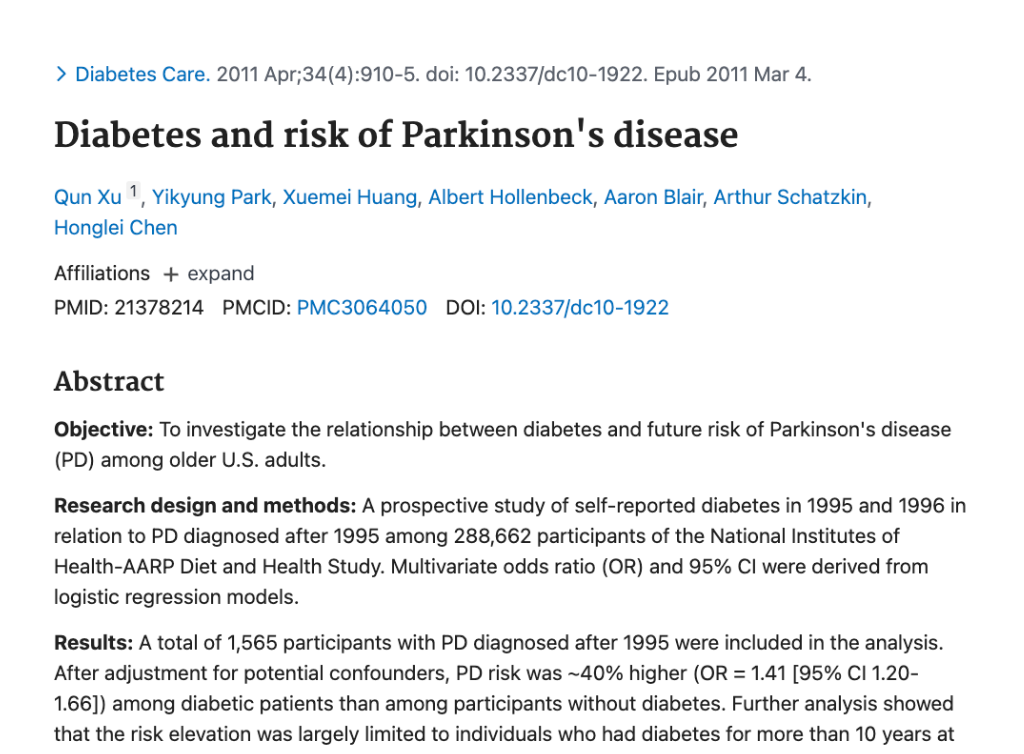
Article Review – Diabetes and Risk of Parkinson’s Disease

Article Review – Diabetes and Risk of Parkinson’s Disease

by Qun Xu, Yikyung Park, Xuemei Huang, Albert Hollenbeck, Aaron Blair, Arthur Schatzkin, Honglei Chen

This article is part of Opti Metabolics’ ongoing effort to translate complex metabolic research into clear, practical insights for readers without formal scientific or medical training.

Summary -

This article investigates the potential link between type 2 diabetes and an increased risk of developing Parkinson’s disease (PD), revealing that long-standing metabolic dysfunction may predispose individuals to neurodegeneration. The findings reinforce the idea that insulin resistance and chronic inflammation—hallmarks of type 2 diabetes—may play a significant role in triggering or accelerating Parkinsonian pathology.

Key Takeaways Explained for a Non-Medical Audience

– The study found a statistically significant association between a history of diabetes and an elevated risk of developing Parkinson’s disease.

– Participants with diabetes for more than 10 years showed a particularly strong correlation with PD onset, suggesting a duration-dependent effect.

– Chronic hyperglycemia and insulin resistance may contribute to neuroinflammation and oxidative stress, which are implicated in PD pathogenesis.

– Diabetes-related mitochondrial dysfunction may impair neuronal survival, particularly in dopamine-producing areas of the brain.

– Advanced glycation end products (AGEs), which are elevated in diabetes, may accelerate neurodegeneration and increase PD vulnerability.

– Insulin receptors in the brain, particularly in the substantia nigra, may influence dopaminergic signaling; their dysfunction could exacerbate PD.

– Inflammation and microvascular damage associated with diabetes may impair blood-brain barrier integrity and promote neurotoxicity.

– Obesity and poor metabolic health—common precursors to diabetes—are independently associated with increased neurodegenerative disease risk.

– The article suggests that improving metabolic health could have protective neurological benefits, potentially lowering the incidence of PD.

– Mid-life metabolic interventions may be more impactful in reducing long-term neurodegenerative risk than treatments initiated after diagnosis.

– Insulin-sensitizing interventions may hold therapeutic potential for neurodegenerative diseases by restoring metabolic integrity at the cellular level.

– The findings align with a growing body of evidence that positions Parkinson’s disease within a broader framework of metabolic and inflammatory disorders.

– Lifestyle-related insulin resistance may not only predispose individuals to diabetes but also compromise long-term cognitive and motor function.

– The research supports a shift toward prevention-focused strategies targeting upstream metabolic dysfunction to delay or prevent neurodegenerative disease.

– Although the association does not prove causation, the consistent patterns found in large cohorts make the metabolic-neurodegenerative link biologically plausible.


Integrated Insights –

This article supports the Opti Metabolics framework by reinforcing the link between insulin resistance and downstream neurodegenerative disorders such as Parkinson’s. It underscores the importance of early lifestyle interventions, mitochondrial support, and carbohydrate reduction to preserve neurological function and prevent chronic disease.

Alignment with Broader Review Content –

– Confirms that insulin resistance has systemic consequences beyond glucose regulation, including increased neurodegenerative risk.

– Aligns with the Opti Metabolics principle that mitochondrial dysfunction and oxidative stress are central to both metabolic and neurological diseases.

– Validates the preventive value of low-carbohydrate and anti-inflammatory strategies in mitigating long-term disease progression.

Reviewed and interpreted by the Opti Metabolics editorial team, with a focus on early metabolic risk detection and prevention.

Read the article to learn more: Diabetes and Risk of Parkinson’s Disease

Health & Medical Disclaimer –

Opti Metabolics does not provide medical diagnosis, treatment, or advice. Our program is for educational and informational purposes only and does not represent medical advice or the practice of medicine. These article summaries are intended to help readers understand metabolic health research and emerging scientific findings, but personal health decisions should always be made in consultation with a qualified healthcare provider.

Participants are strongly advised to consult their personal healthcare professional before making any dietary, lifestyle, or medication changes.

x
Opti Metabolics provides informational health insights and does not dispense medical advice, diagnose, treat, or cure any medical conditions. Always consult a qualified healthcare professional before making any health-related decisions.

Contact With Us!

Email: info@optimetabolics.com

Join Opti Metabolics

It’s time to take control of your health.

Eat Like a Human Again

Drop your name and email to receive the eBook that shows how returning to simple, whole foods can restore stable energy, support metabolic health, and help your body function the way it was designed to.
Name

The Fast Track to Frailty

Drop your name and email to receive the guide that helps you understand how GLP-1 weight loss changes your body, and why the scale alone never tells the full story.
Name

Starving for Nothing

Drop your name and email to receive the eBook that shows why “Eat Less, Move More” was never your fault. It was the wrong story, and now you get the right one.
Name