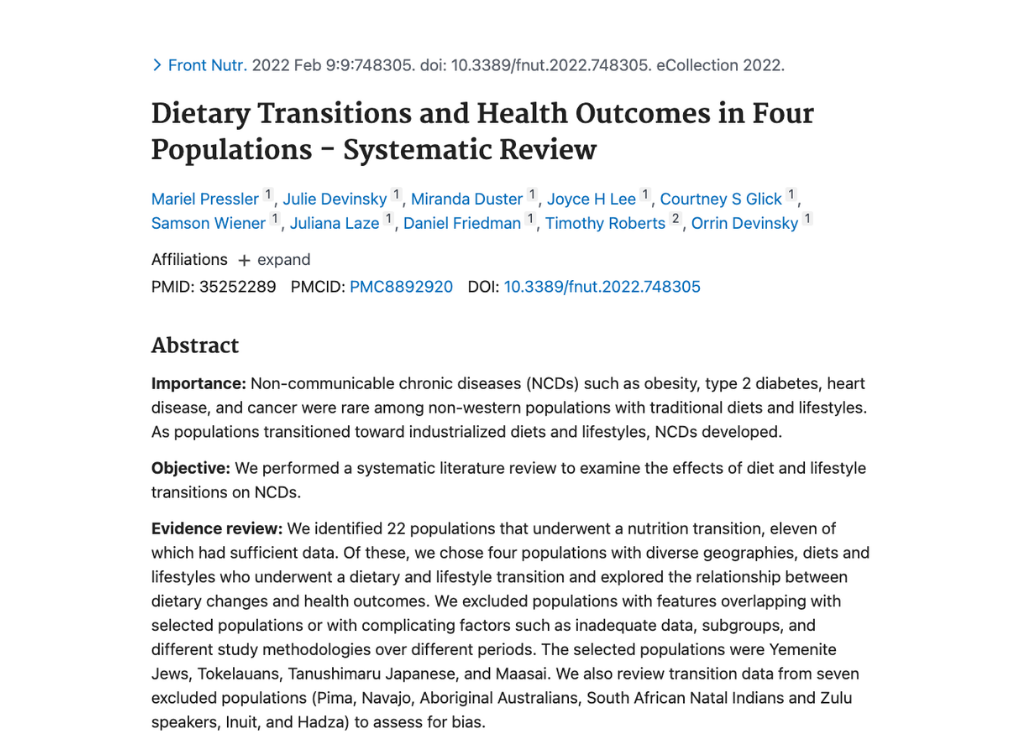
Article Review – Dietary Transitions and Health Outcomes in Four Populations – Systematic Review

Article Review – Dietary Transitions and Health Outcomes in Four Populations – Systematic Review

by Mariel Pressler, Julie Devinsky, Miranda Duster, Joyce H Lee, Courtney S Glick, Samson Wiener, Juliana Laze, Daniel Friedman, Timothy Roberts, Orrin Devinsky

This article is part of Opti Metabolics’ ongoing effort to translate complex metabolic research into clear, practical insights for readers without formal scientific or medical training.

Summary -

This systematic review examines dietary shifts in four diverse populations—Yemenite Jews, Tokelauans, Tanushimaru Japanese, and Maasai—transitioning from traditional to westernized diets, finding that increases in refined carbohydrates and sugars strongly correlate with rising rates of non-communicable diseases like obesity, diabetes, heart disease, and cancer, while total fat or saturated fat intake shows no such association. The findings underscore the role of refined carbohydrate consumption in driving metabolic dysfunction and insulin resistance, suggesting that maintaining low-carbohydrate, nutrient-dense traditional diets could prevent these chronic conditions. Implications for metabolic health emphasize prioritizing natural, low-carb approaches to mitigate inflammation and improve energy regulation.

Key Takeaways Explained for a Non-Medical Audience

– The review analyzed 22 populations undergoing nutrition transitions, selecting four with sufficient data and diverse backgrounds for in-depth study.

– Across 11 populations with adequate data, non-communicable diseases were more strongly linked to increased refined carbohydrates than to higher calories, reduced activity, or other factors.

– Yemenite Jews experienced a 600% increase in added sugar, 240% rise in polyunsaturated fats, and 43% drop in saturated fats post-transition, leading to higher BMI and diabetes prevalence.

– In Tokelauans, carbohydrate intake rose by 25% and sugar by up to 650% among migrants, with a 23% reduction in saturated fats, resulting in increased obesity, diabetes, and heart disease.

– Tanushimaru Japanese saw a 19% decrease in carbohydrates, 119% increase in fats, and 31% rise in proteins, correlating with stable or improved health outcomes and lower disease rates.

– Maasai women increased carbohydrates by 362% and decreased proteins by 73% and fats by 62%, associated with higher obesity, hypertension, and cardiovascular risks.

– No association was found between total fat or saturated fat intake and non-communicable disease risk in any population.

– Three populations (Yemenite Jews, Tokelauans, Maasai) replaced saturated fats from animal or plant sources with refined carbohydrates, yielding negative health effects.

– Increased polyunsaturated fats, potentially from seed oils, accompanied transitions in Yemenite Jews and Tokelauans, contributing to metabolic stress.

– Fiber intake decreased significantly in Yemenite Jews (35%) and other groups, exacerbating blood sugar dysregulation.

– Diabetes prevalence rose dramatically, from near zero in traditional settings to 6-12% post-transition in Yemenite Jews and Tokelauans.

– Heart disease indicators, such as atherosclerosis and hypertension, increased in Maasai and Yemenite Jews following dietary shifts.

– Cancer rates, including colon and breast, were noted to rise in transitioning populations like Yemenite Jews.

– Physical activity reductions and caloric increases were inconsistent factors, not primary drivers of disease.

– Excluded populations like Pima Indians showed similar patterns, reinforcing the role of refined carbohydrates in insulin resistance and chronic diseases.


Integrated Insights –

This article aligns with the Opti Metabolics framework by highlighting how excessive refined carbohydrate intake promotes insulin resistance and metabolic dysfunction, which can be addressed through low-carbohydrate or ketogenic diets rich in natural fats and proteins. It supports the Purple Zone principle of balancing metabolic health by avoiding inflammatory seed oils and prioritizing whole foods to reduce chronic disease risk.

Alignment with Broader Review Content –

– Reinforces evidence that insulin resistance from high-carb diets underlies conditions like diabetes and heart disease, consistent with studies on metabolic stress.

– Highlights the inflammatory potential of increased polyunsaturated fats from seed oils, aligning with research on oxidative stress and chronic inflammation.

– Supports the efficacy of low-carb diets in preventing non-communicable diseases, as seen in the positive outcomes for the Tanushimaru Japanese population.

Reviewed and interpreted by the Opti Metabolics editorial team, with a focus on early metabolic risk detection and prevention.

Read the article to learn more: Dietary Transitions and Health Outcomes in Four Populations – Systematic Review

Health & Medical Disclaimer –

Opti Metabolics does not provide medical diagnosis, treatment, or advice. Our program is for educational and informational purposes only and does not represent medical advice or the practice of medicine. These article summaries are intended to help readers understand metabolic health research and emerging scientific findings, but personal health decisions should always be made in consultation with a qualified healthcare provider.

Participants are strongly advised to consult their personal healthcare professional before making any dietary, lifestyle, or medication changes.

x
Opti Metabolics provides informational health insights and does not dispense medical advice, diagnose, treat, or cure any medical conditions. Always consult a qualified healthcare professional before making any health-related decisions.

Contact With Us!

Email: info@optimetabolics.com

Join Opti Metabolics

It’s time to take control of your health.

Eat Like a Human Again

Drop your name and email to receive the eBook that shows how returning to simple, whole foods can restore stable energy, support metabolic health, and help your body function the way it was designed to.
Name

The Fast Track to Frailty

Drop your name and email to receive the guide that helps you understand how GLP-1 weight loss changes your body, and why the scale alone never tells the full story.
Name

Starving for Nothing

Drop your name and email to receive the eBook that shows why “Eat Less, Move More” was never your fault. It was the wrong story, and now you get the right one.
Name