Email: success@optimetabolics.com
This article is part of Opti Metabolics’ ongoing effort to translate complex metabolic research into clear, practical insights for readers without formal scientific or medical training.
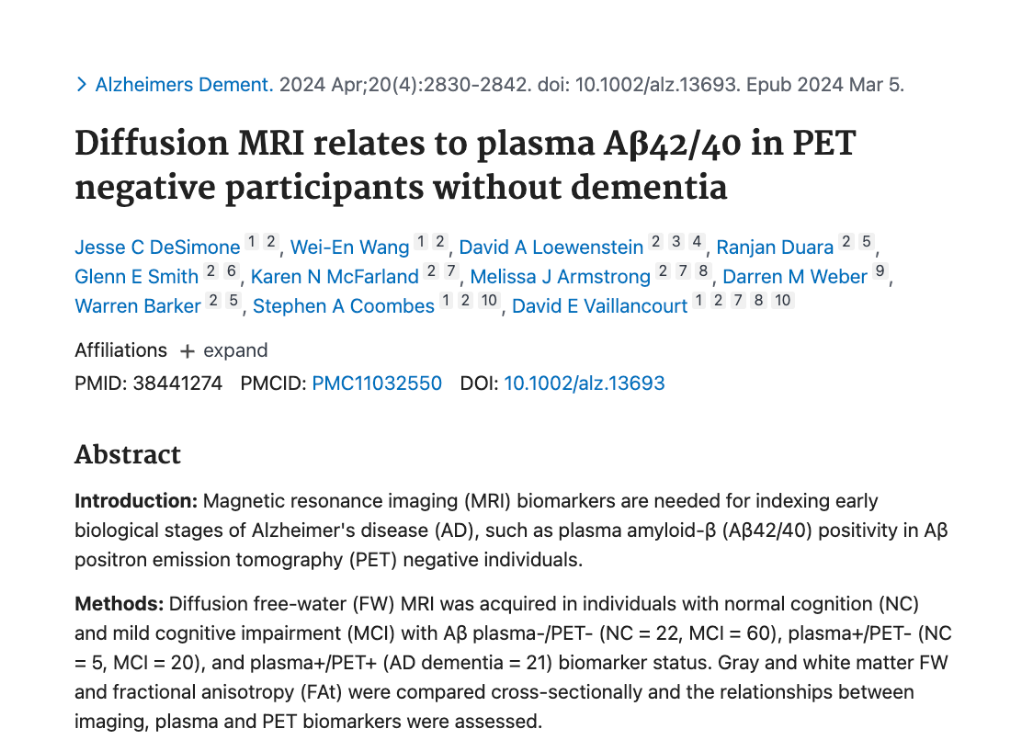
This study demonstrates that diffusion MRI metrics, such as increased free water and decreased fractional anisotropy, are associated with plasma Aβ42/40 positivity in amyloid PET-negative individuals without dementia, revealing subtle brain microstructure alterations indicative of early Alzheimer’s pathology. These changes occur independently of cognitive status, PET results, and other plasma biomarkers, highlighting plasma Aβ42/40 as a sensitive early marker for neurodegeneration. For metabolic health and prevention, early identification of such biomarkers underscores the need to address underlying insulin resistance through low-carbohydrate or ketogenic diets to improve brain energy metabolism, reduce oxidative stress, and potentially halt progression to clinical dementia.
– Magnetic resonance imaging biomarkers are essential for detecting early biological stages of Alzheimer’s disease, particularly plasma Aβ42/40 positivity in Aβ PET-negative individuals.
– Diffusion free-water MRI was used to assess gray and white matter free water and fractional anisotropy in participants with normal cognition and mild cognitive impairment.
– The study included plasma-/PET- (normal cognition = 22, mild cognitive impairment = 60), plasma+/PET- (normal cognition = 5, mild cognitive impairment = 20), and plasma+/PET+ (Alzheimer’s dementia = 21) groups.
– Plasma Aβ42/40 positivity is linked to brain microstructure decline, even in the absence of detectable amyloid on PET scans.
– Plasma+/PET- participants showed increased free water in 24 total gray and white matter regions compared to plasma-/PET-.
– Plasma+/PET- demonstrated decreased fractional anisotropy in 66 total gray and white matter regions compared to plasma-/PET-.
– In plasma+/PET+ compared to plasma+/PET-, free water was increased in 16 regions and fractional anisotropy was increased in 51 regions.
– Composite whole-brain free water correlated with plasma Aβ42/40 ratios and p-tau181 levels.
– These diffusion MRI changes distinguish plasma Aβ42/40 positive and negative groups independent of cognitive status, Aβ PET status, and other plasma biomarkers like t-tau, p-tau181, glial fibrillary acidic protein, and neurofilament light.
– Plasma+/PET- also exhibited decreased cortical volume and thickness, suggesting early structural impacts.
– Plasma Aβ42/40 was measured using high-throughput liquid chromatography/tandem mass spectrometry via the Quest AD-Detect test.
– The findings support plasma Aβ42/40 as a surrogate for early brain amyloidosis, with a 15-fold higher risk of converting to PET positive in plasma+/PET- individuals.
– Diffusion free-water imaging emerges as a noninvasive tool for monitoring neurodegenerative changes related to isolated plasma Aβ42/40 positivity.
– Cross-sectional comparisons and correlations were used in statistical analyses, with high area-under-the-curve values for predicting PET status from plasma measures.
– The study highlights the potential of combining plasma biomarkers and diffusion MRI for early diagnosis and progression monitoring in Alzheimer’s disease.
This article connects to the Opti Metabolics framework by illustrating how early Alzheimer’s pathology, detected via plasma Aβ42/40 and diffusion MRI, may stem from metabolic disruptions like insulin resistance that impair brain glucose utilization and promote amyloid accumulation. Implementing low-carbohydrate or ketogenic diets can enhance metabolic flexibility, reduce reliance on carbohydrates, and lower inflammation and oxidative stress, offering preventive strategies against these subtle brain changes. By addressing root metabolic causes, such approaches align with Opti Metabolics’ emphasis on natural interventions to mitigate neurodegeneration and chronic conditions.
– Links plasma Aβ42/40 positivity to early microstructure decline, paralleling discussions on insulin resistance and oxidative stress as shared drivers in Alzheimer’s and diabetes.
– Reinforces the value of non-invasive biomarkers like diffusion MRI for detecting preclinical changes, consistent with content on ketogenic diets reducing tau and amyloid pathologies in dementia models.
– Integrates findings with lifestyle risks, aligning with reviews on how metabolic optimization through low-carb strategies prevents progression in all-cause dementia and related inflammatory conditions.
Reviewed and interpreted by the Opti Metabolics editorial team, with a focus on early metabolic risk detection and prevention.
Read the article to learn more: Diffusion MRI Relates to Plasma Aβ42/40 in PET Negative Participants Without Dementia
Opti Metabolics does not provide medical diagnosis, treatment, or advice. Our program is for educational and informational purposes only and does not represent medical advice or the practice of medicine. These article summaries are intended to help readers understand metabolic health research and emerging scientific findings, but personal health decisions should always be made in consultation with a qualified healthcare provider.
Participants are strongly advised to consult their personal healthcare professional before making any dietary, lifestyle, or medication changes.
Email: info@optimetabolics.com
It’s time to take control of your health.