Email: success@optimetabolics.com
This article is part of Opti Metabolics’ ongoing effort to translate complex metabolic research into clear, practical insights for readers without formal scientific or medical training.
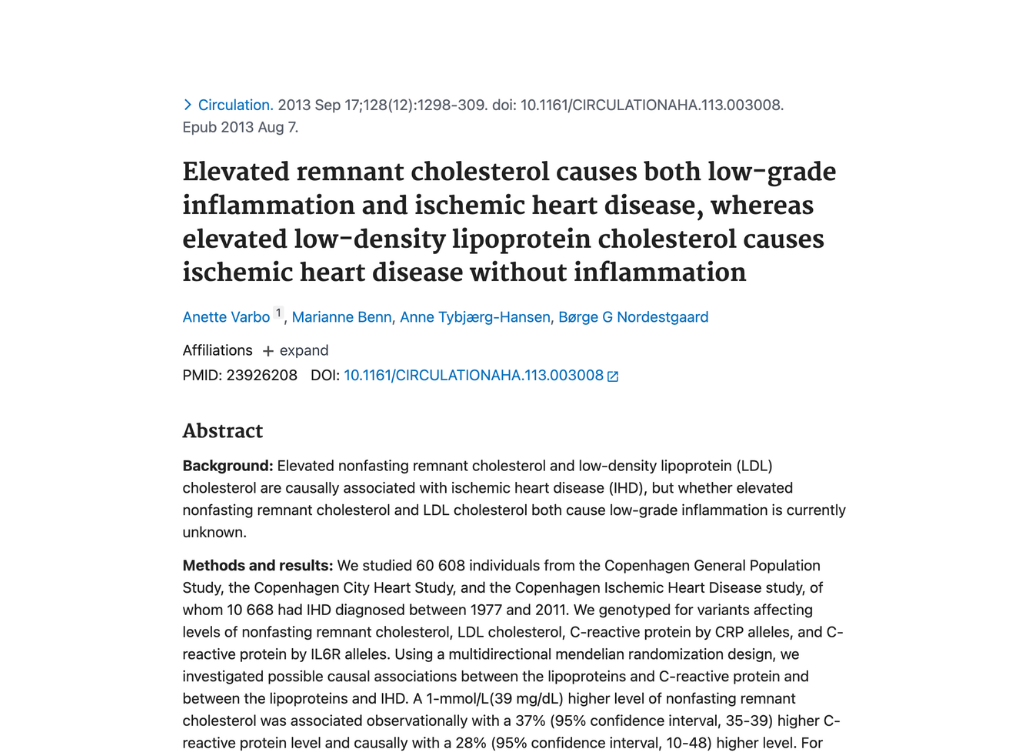
This study demonstrates that elevated nonfasting remnant cholesterol is causally linked to both low-grade inflammation, as indicated by higher C-reactive protein levels, and ischemic heart disease, while elevated LDL cholesterol contributes causally only to ischemic heart disease without causing inflammation. Using Mendelian randomization in over 60,000 participants, the research highlights remnant cholesterol’s stronger causal role in inflammation-mediated heart disease pathways. For metabolic health and prevention, these findings underscore the importance of addressing remnant cholesterol through strategies like low-carbohydrate diets to reduce triglyceride-rich lipoproteins and mitigate insulin resistance-driven risks.
– Elevated nonfasting remnant cholesterol is causally associated with low-grade inflammation and ischemic heart disease.
– Elevated LDL cholesterol is causally associated with ischemic heart disease but not with low-grade inflammation.
– The study involved 60,608 individuals from three Copenhagen cohorts, with 10,668 cases of ischemic heart disease.
– Mendelian randomization was used to establish causal relationships by genotyping variants affecting remnant cholesterol, LDL cholesterol, and C-reactive protein levels.
– A 1 mmol/L increase in remnant cholesterol was observationally linked to a 37% higher C-reactive protein level.
– Causally, a 1 mmol/L increase in remnant cholesterol led to a 28% higher C-reactive protein level.
– For LDL cholesterol, a 1 mmol/L increase was observationally associated with a 7% higher C-reactive protein level, but no causal link was found.
– Higher C-reactive protein levels did not causally affect remnant or LDL cholesterol levels.
– The causal risk ratio for ischemic heart disease was 3.3 for a 1 mmol/L increase in remnant cholesterol.
– The causal risk ratio for ischemic heart disease was 1.8 for a 1 mmol/L increase in LDL cholesterol.
– Causal associations for remnant cholesterol and ischemic heart disease persisted even in individuals without diabetes or obesity.
– Remnant cholesterol represents the cholesterol content of triglyceride-rich lipoproteins, including very low-density lipoproteins, intermediate-density lipoproteins, and chylomicron remnants.
– Statins may reduce cardiovascular risk partly by lowering remnant cholesterol and inflammation, beyond just LDL cholesterol reduction.
– The findings suggest that remnant cholesterol may promote atherosclerosis through direct accumulation in the arterial wall, similar to LDL but with added inflammatory effects.
This article aligns with the Opti Metabolics framework by emphasizing how remnant cholesterol, often elevated due to insulin resistance from excessive carbohydrate intake, drives inflammation and heart disease, which can be addressed through low-carbohydrate or ketogenic diets that lower triglycerides and improve metabolic health. It reinforces the role of natural, well-formulated dietary interventions to mitigate these risks without contradicting the avoidance of omega-6-rich seed oils that exacerbate inflammation.
– Supports the view that insulin resistance underlies chronic conditions like heart disease by impairing lipid management, particularly elevating remnant cholesterol.
– Highlights inflammation as a key mediator in metabolic diseases, consistent with reducing carbohydrate-driven stresses and inflammatory seed oils.
– Aligns with promoting low-carbohydrate diets to lower remnant cholesterol and prevent ischemic heart disease, enhancing overall metabolic optimization.
Reviewed and interpreted by the Opti Metabolics editorial team, with a focus on early metabolic risk detection and prevention.
Read the article to learn more: Elevated Remnant Cholesterol Causes Both Low-Grade Inflammation and Ischemic Heart Disease, Whereas Elevated Low-Density Lipoprotein Cholesterol Causes Ischemic Heart Disease Without Inflammation
Opti Metabolics does not provide medical diagnosis, treatment, or advice. Our program is for educational and informational purposes only and does not represent medical advice or the practice of medicine. These article summaries are intended to help readers understand metabolic health research and emerging scientific findings, but personal health decisions should always be made in consultation with a qualified healthcare provider.
Participants are strongly advised to consult their personal healthcare professional before making any dietary, lifestyle, or medication changes.
Email: info@optimetabolics.com
It’s time to take control of your health.