Article Review – Increased Cancer Mortality Among Japanese Individuals with Hyperinsulinemia

Article Review – Increased Cancer Mortality Among Japanese Individuals with Hyperinsulinemia

by Sakurako Kira, Chikako Ito, Rumi Fujikawa, Munechika Misumi

This article is part of Opti Metabolics’ ongoing effort to translate complex metabolic research into clear, practical insights for readers without formal scientific or medical training.

Summary -

This study demonstrates that hyperinsulinemia is significantly associated with increased cancer mortality among Japanese adults, independent of factors like age, sex, BMI, and glucose levels, highlighting insulin’s role as a potential driver of cancer risk even in prediabetic and diabetic states. The findings underscore the importance of addressing hyperinsulinemia for metabolic health and cancer prevention, as elevated fasting insulin levels correlate with higher hazard ratios for cancer death across glucose tolerance categories. By mitigating insulin resistance through lifestyle interventions, individuals may reduce their susceptibility to chronic diseases like cancer, aligning with strategies that promote metabolic optimization.

Key Takeaways Explained for a Non-Medical Audience

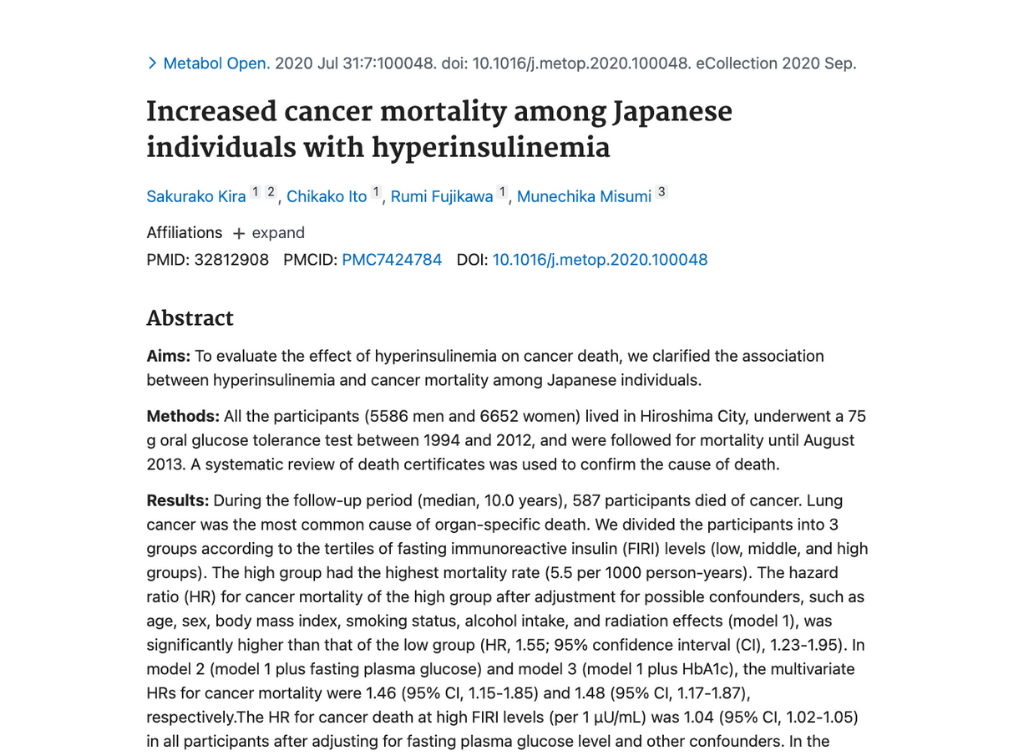
– The study involved 12,238 participants (5,586 men and 6,652 women) from Hiroshima City who underwent a 75 g oral glucose tolerance test between 1994 and 2012.

– Participants were followed for mortality until August 2013, with a median follow-up period of 10.0 years.

– During follow-up, 587 participants died of cancer, with lung cancer being the most common organ-specific cause.

– Participants were divided into three groups based on tertiles of fasting immunoreactive insulin (FIRI) levels: low, middle, and high.

– The high FIRI group had the highest cancer mortality rate at 5.5 per 1000 person-years.

– The hazard ratio (HR) for cancer mortality in the high FIRI group compared to the low group was 1.55 (95% CI, 1.23-1.95) after adjusting for age, sex, BMI, smoking, alcohol intake, and radiation effects (model 1).

– After further adjustment for fasting plasma glucose (model 2), the HR was 1.46 (95% CI, 1.15-1.85).

– After adjustment for HbA1c instead (model 3), the HR was 1.48 (95% CI, 1.17-1.87).

– The HR for cancer death per 1 μU/mL increase in FIRI levels was 1.04 (95% CI, 1.02-1.05) after adjusting for fasting plasma glucose and other confounders.

– In subgroup analysis, the HR per 1 μU/mL FIRI increase was 1.03 (95% CI, 0.98-1.09) in the normal glucose tolerance group.

– The HR was 1.05 (95% CI, 1.02-1.08) in the prediabetes group.

– The HR was 1.04 (95% CI, 1.02-1.06) in the diabetes group.

– Hyperinsulinemia showed a consistent association with cancer mortality across different glucose tolerance statuses.

– The study suggests hyperinsulinemia may link cancer mortality to diabetes or prediabetes.

– Results indicate that managing insulin levels could be key in reducing cancer risk.

Integrated Insights –

This article reinforces the Opti Metabolics framework by illustrating how hyperinsulinemia, a hallmark of insulin resistance often exacerbated by high-carbohydrate diets, contributes to cancer mortality, emphasizing the need for metabolic interventions. Within The Purple Zone principles, which focus on achieving optimal metabolic balance to minimize chronic disease risks, these findings support prioritizing low-carbohydrate or ketogenic approaches to lower insulin levels and enhance overall health resilience. By addressing underlying metabolic stressors like elevated insulin, individuals can potentially mitigate cancer risks in line with natural, whole-food-based strategies.

Alignment with Broader Review Content –

– This study aligns with evidence linking insulin resistance to increased cancer risks, as hyperinsulinemia promotes cellular proliferation and inflammation, consistent with patterns seen in metabolic syndrome.

– It supports the view that excessive carbohydrate intake drives insulin spikes, contributing to chronic conditions, and underscores the benefits of low-carbohydrate diets in reducing such risks.

– The association remains significant after adjusting for glucose markers, reinforcing that insulin management is crucial beyond glycemic control, and avoiding omega-6-rich oils could further alleviate related inflammatory stresses.

Reviewed and interpreted by the Opti Metabolics editorial team, with a focus on early metabolic risk detection and prevention.

Read the article to learn more: Increased Cancer Mortality Among Japanese Individuals with Hyperinsulinemia

Health & Medical Disclaimer –

Opti Metabolics does not provide medical diagnosis, treatment, or advice. Our program is for educational and informational purposes only and does not represent medical advice or the practice of medicine. These article summaries are intended to help readers understand metabolic health research and emerging scientific findings, but personal health decisions should always be made in consultation with a qualified healthcare provider.

Participants are strongly advised to consult their personal healthcare professional before making any dietary, lifestyle, or medication changes.

x
Opti Metabolics provides informational health insights and does not dispense medical advice, diagnose, treat, or cure any medical conditions. Always consult a qualified healthcare professional before making any health-related decisions.

Contact With Us!

Email: info@optimetabolics.com

Join Opti Metabolics

It’s time to take control of your health.

Eat Like a Human Again

Drop your name and email to receive the eBook that shows how returning to simple, whole foods can restore stable energy, support metabolic health, and help your body function the way it was designed to.
Name

The Fast Track to Frailty

Drop your name and email to receive the guide that helps you understand how GLP-1 weight loss changes your body, and why the scale alone never tells the full story.
Name

Starving for Nothing

Drop your name and email to receive the eBook that shows why “Eat Less, Move More” was never your fault. It was the wrong story, and now you get the right one.
Name