Email: success@optimetabolics.com
This article is part of Opti Metabolics’ ongoing effort to translate complex metabolic research into clear, practical insights for readers without formal scientific or medical training.
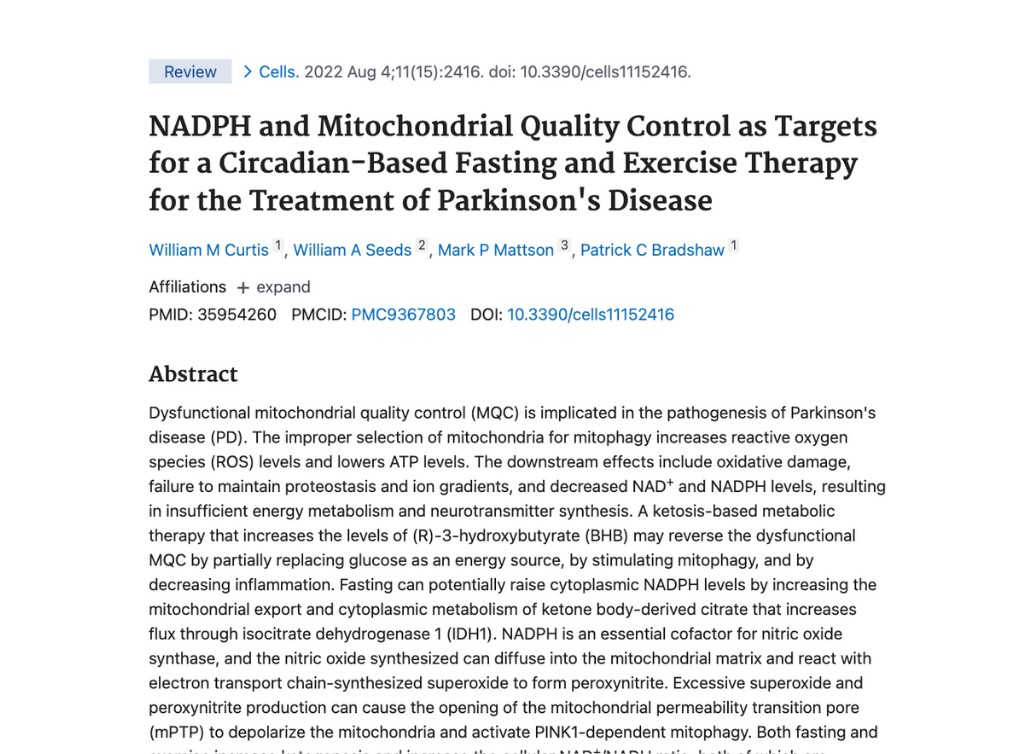
This article proposes that Parkinson’s disease (PD) involves impaired mitochondrial quality control exacerbated by decreased NAD⁺ and NADPH, leading to energy deficits, oxidative damage, and neuronal dysfunction. It outlines a circadian-aligned therapeutic strategy combining fasting, exercise, and ketosis to restore NADPH levels, stimulate mitophagy, improve metabolic resilience, and potentially slow PD progression.
– Dysfunctional mitochondrial quality control (MQC) in PD leads to elevated reactive oxygen species and reduced ATP production.
– Lower NAD⁺ and NADPH levels impair energy metabolism and neurotransmitter synthesis in PD neurons.
– Ketosis, via (R)-3‑hydroxybutyrate (BHB), may partially substitute for glucose as fuel, reduce inflammation, and stimulate mitophagy.
– Fasting increases cytoplasmic NADPH by promoting mitochondrial export of citrate that feeds isocitrate dehydrogenase 1 (IDH1).
– NADPH is essential for nitric oxide synthase activity; nitric oxide then interacts with mitochondrial superoxide to activate PINK1-dependent mitophagy.
– Both fasting and exercise elevate NAD⁺/NADH ratios and promote circadian-aligned mitophagy gene expression.
– Circadian timing—fasting from evening meal to next-day lunch combined with morning exercise—leverages natural peaks in NAD⁺/NADH and NADP⁺/NADPH cycles.
– Adaptive stress responses triggered by intermittent fasting and exercise may confer neuroprotection against oxidative and proteotoxic stress in PD.
– Aligning therapeutic interventions with circadian rhythms may enhance mitochondrial turnover and cellular resilience.
– The strategy centers on realigning metabolism through natural stimuli rather than pharmacologic suppression, fostering systemic metabolic restoration.
– This approach integrates metabolic, mitochondrial, and circadian biology into a cohesive therapeutic model for neurodegenerative disease.
– The therapy addresses both root causes—mitochondrial dysfunction and NADPH deficit—rather than symptomatic outcomes.
– Fresh metabolic stressors like fasting and exercise serve as signals for improved energy homeostasis and neuronal protection.
– Ketosis serves dual roles in energy provision and activation of mitochondrial quality control pathways.
This article exemplifies the Opti Metabolics philosophy by combining circadian-aligned fasting, exercise, and ketosis to restore NADPH, support mitochondrial integrity, and reduce inflammation. It underscores the systemic efficacy of natural metabolic interventions over pharmaceutical reliance in chronic neurological disease.
– Highlights the central role of mitochondrial dysfunction and oxidative stress in neurodegeneration, reinforcing metabolic health as foundational.
– Supports ketogenic and low-carbohydrate strategies to enhance mitochondrial resilience and mitigate insulin resistance.
– Demonstrates the power of lifestyle-aligned metabolic timing (fasting, circadian-awareness, exercise) to drive meaningful cellular repair and disease prevention.
Reviewed and interpreted by the Opti Metabolics editorial team, with a focus on early metabolic risk detection and prevention.
Read the article to learn more: NADPH and Mitochondrial Quality Control as Targets for a Circadian-Based Fasting and Exercise Therapy for the Treatment of Parkinson’s Disease
Opti Metabolics does not provide medical diagnosis, treatment, or advice. Our program is for educational and informational purposes only and does not represent medical advice or the practice of medicine. These article summaries are intended to help readers understand metabolic health research and emerging scientific findings, but personal health decisions should always be made in consultation with a qualified healthcare provider.
Participants are strongly advised to consult their personal healthcare professional before making any dietary, lifestyle, or medication changes.
Email: info@optimetabolics.com
It’s time to take control of your health.