Email: success@optimetabolics.com
This article is part of Opti Metabolics’ ongoing effort to translate complex metabolic research into clear, practical insights for readers without formal scientific or medical training.
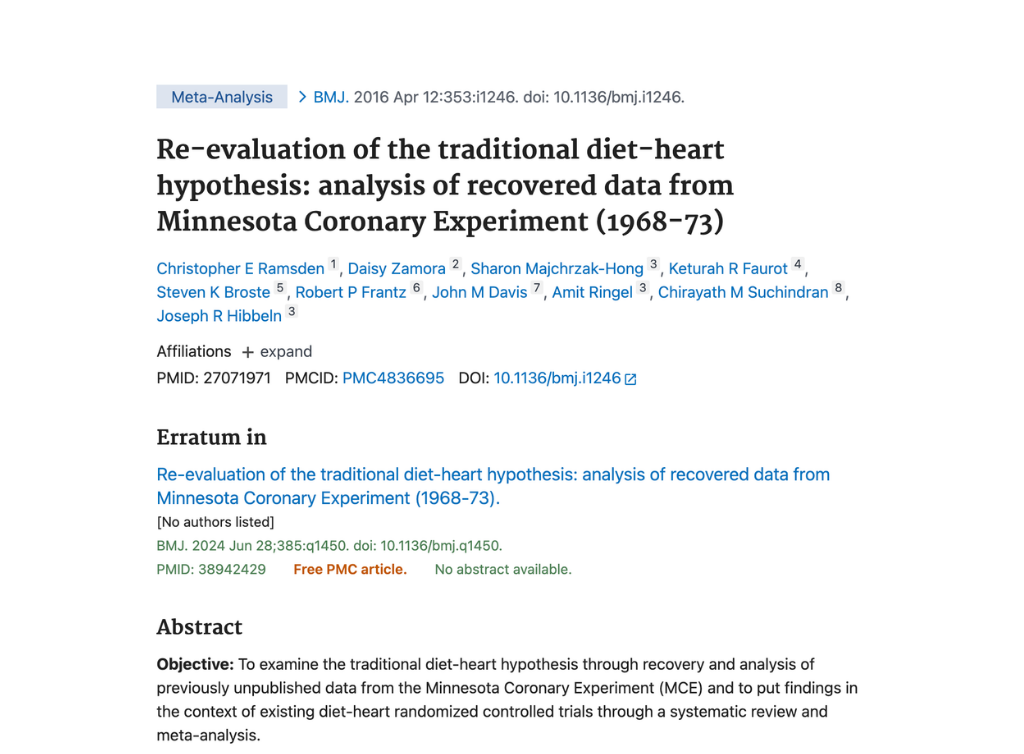
The re-evaluation of the Minnesota Coronary Experiment (1968-73) challenges the traditional diet-heart hypothesis, finding that replacing saturated fat with linoleic acid-rich vegetable oil lowers serum cholesterol but does not reduce coronary heart disease or mortality. These findings suggest that high omega-6 fatty acid intake, common in seed oils, may not confer cardiovascular benefits and could contribute to metabolic stress and inflammation, aligning with concerns about modern dietary patterns.
– The Minnesota Coronary Experiment (MCE) was a double-blind randomized controlled trial conducted from 1968 to 1973 to test the diet-heart hypothesis.
– The trial aimed to determine if replacing saturated fat with vegetable oil rich in linoleic acid reduces coronary heart disease and death by lowering serum cholesterol.
– Recovered unpublished data from the MCE was analyzed to evaluate the original hypotheses set by the investigators.
– The intervention group reduced saturated fat intake by approximately 50% and increased linoleic acid intake by over 280%.
– The control group maintained high saturated fat intake but increased linoleic acid intake by about 38%.
– Both groups experienced cholesterol-lowering effects, as predicted by the Keys equation, due to dietary changes.
– Despite lowering serum cholesterol, the intervention group showed no reduction in coronary heart disease or all-cause mortality.
– Autopsy data from 149 participants showed a 47% increase in atherosclerosis in the intervention group compared to controls.
– The systematic review and meta-analysis included other randomized controlled trials replacing saturated fat with linoleic acid-rich oils.
– The meta-analysis found no evidence that replacing saturated fat with linoleic acid reduces coronary heart disease or mortality.
– Increased linoleic acid intake may contribute to inflammation and oxidative stress, potentially exacerbating metabolic health issues.
– The study highlights incomplete publication of earlier trials, which may have overestimated the benefits of linoleic acid-rich oils.
– The findings question the long-standing recommendation to replace saturated fats with polyunsaturated fats high in omega-6.
– Dietary linoleic acid’s role in cardiovascular health requires further scrutiny, particularly its impact on long-term outcomes.
– The MCE results suggest that high omega-6 intake may not be protective and could have unintended metabolic consequences.
The MCE findings align with the Opti Metabolics framework, which emphasizes reducing omega-6-rich seed oils to mitigate inflammation and metabolic stress. High linoleic acid intake, as tested in the MCE, may exacerbate insulin resistance and chronic inflammatory stresses, supporting the need for low-carbohydrate or ketogenic diets to optimize metabolic health. These insights challenge conventional dietary guidelines and advocate for a re-evaluation of fat sources in disease prevention.
– Supports the view that excessive omega-6 fatty acids, prevalent in modern diets, contribute to chronic inflammatory stresses and metabolic dysfunction.
– Reinforces the importance of dietary interventions, like low-carb or ketogenic diets, that prioritize natural, minimally processed fats over seed oils.
– Highlights the need to critically assess historical dietary recommendations, particularly those promoting high omega-6 intake, in light of metabolic health outcomes.
Reviewed and interpreted by the Opti Metabolics editorial team, with a focus on early metabolic risk detection and prevention.
Read the article to learn more: Re-evaluation of the Traditional Diet-Heart Hypothesis: Analysis of Recovered Data from Minnesota Coronary Experiment (1968-73)
Opti Metabolics does not provide medical diagnosis, treatment, or advice. Our program is for educational and informational purposes only and does not represent medical advice or the practice of medicine. These article summaries are intended to help readers understand metabolic health research and emerging scientific findings, but personal health decisions should always be made in consultation with a qualified healthcare provider.
Participants are strongly advised to consult their personal healthcare professional before making any dietary, lifestyle, or medication changes.
Email: info@optimetabolics.com
It’s time to take control of your health.