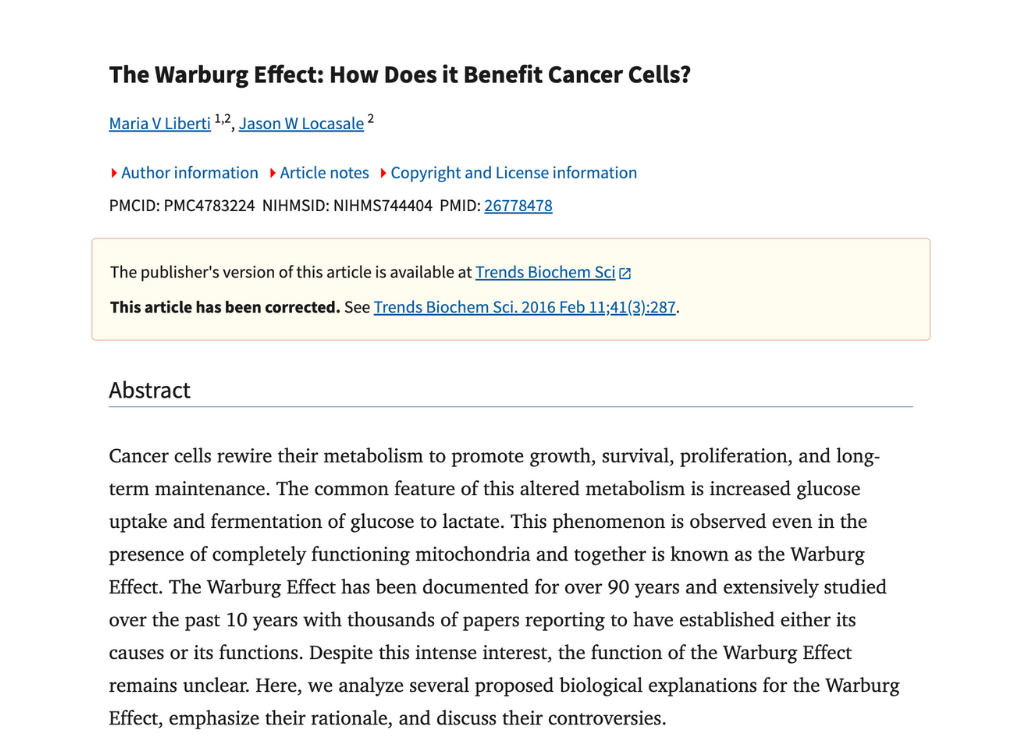
Article Review – The Warburg Effect: How Does it Benefit Cancer Cells?

Article Review – The Warburg Effect: How Does it Benefit Cancer Cells?

by Maria V. Liberti, Jason W. Locasale

This article is part of Opti Metabolics’ ongoing effort to translate complex metabolic research into clear, practical insights for readers without formal scientific or medical training.

Summary -

The Warburg Effect describes cancer cells’ preference for aerobic glycolysis, converting glucose to lactate even in oxygen-rich conditions, to support rapid proliferation and survival. This metabolic shift, extensively studied yet not fully understood, may drive chronic conditions by exploiting glucose dependency, potentially mitigated by dietary strategies like ketogenic diets that limit glucose availability. Understanding this mechanism offers insights into targeting cancer metabolism for prevention and treatment.

Key Takeaways Explained for a Non-Medical Audience

– Cancer cells exhibit increased glucose uptake and convert glucose to lactate, even with functional mitochondria, a phenomenon termed the Warburg Effect.

– This metabolic reprogramming supports rapid cell proliferation by providing energy and biosynthetic precursors for nucleotides, lipids, and proteins.

– Aerobic glycolysis generates ATP less efficiently than mitochondrial respiration but at a faster rate, meeting the high energy demands of cancer cells.

– The Warburg Effect may provide cancer cells with a survival advantage by creating an acidic tumor microenvironment that promotes metastasis and immunosuppression.

– Increased glucose consumption supports the pentose phosphate pathway, producing NADPH to combat oxidative stress in cancer cells.

– The conversion of pyruvate to lactate regenerates NAD+, sustaining glycolysis and supporting cancer cell growth.

– The Warburg Effect’s role in cancer is complex, with proposed functions including biomass production, signaling, and microenvironment modulation.

– Despite extensive research, the precise benefits and drivers of the Warburg Effect in cancer remain unclear, with ongoing debates about its primary function.

– Both glycolysis and mitochondrial metabolism are essential for cancer cell proliferation, challenging early assumptions of mitochondrial dysfunction.

– The Warburg Effect may be exploited therapeutically by targeting glucose metabolism, potentially through dietary interventions like carbohydrate restriction.

– Lactate production from aerobic glycolysis acidifies the tumor microenvironment, potentially enhancing tumor progression and immune evasion.

– The Warburg Effect was first observed by Otto Warburg in the 1920s, noting tumors’ high glucose uptake compared to normal tissues.

– Recent studies suggest the Warburg Effect supports anabolic processes, diverting carbon from glucose into pathways for cellular building blocks.

– Genetic and pharmacological studies confirm the Warburg Effect is required for tumor growth, making it a potential therapeutic target.

– Signal transduction functions of the Warburg Effect are hypothesized but challenging to test experimentally, requiring further research.


Integrated Insights –

The Warburg Effect underscores the link between metabolic dysregulation and cancer, aligning with Opti Metabolics’ focus on addressing insulin resistance and inflammation through low-carbohydrate diets. By reducing glucose availability, ketogenic diets may starve cancer cells reliant on aerobic glycolysis, supporting metabolic health. This approach complements the Purple Zone’s emphasis on lifestyle interventions to mitigate chronic disease risk.

Alignment with Broader Review Content –

– The Warburg Effect’s reliance on glucose metabolism highlights the role of insulin resistance in fueling cancer, consistent with Opti Metabolics’ view that excessive carbohydrates exacerbate chronic conditions.

– Dietary strategies like ketogenic diets, which reduce glucose and insulin levels, align with the article’s implications for targeting cancer metabolism, supporting the Purple Zone’s focus on natural, low-carb interventions.

– The article’s emphasis on oxidative stress and inflammation in cancer progression reinforces Opti Metabolics’ concern with omega-6-rich seed oils and their role in promoting metabolic stress.

Reviewed and interpreted by the Opti Metabolics editorial team, with a focus on early metabolic risk detection and prevention.

Read the article to learn more: The Warburg Effect: How Does it Benefit Cancer Cells?

Health & Medical Disclaimer –

Opti Metabolics does not provide medical diagnosis, treatment, or advice. Our program is for educational and informational purposes only and does not represent medical advice or the practice of medicine. These article summaries are intended to help readers understand metabolic health research and emerging scientific findings, but personal health decisions should always be made in consultation with a qualified healthcare provider.

Participants are strongly advised to consult their personal healthcare professional before making any dietary, lifestyle, or medication changes.

x
Opti Metabolics provides informational health insights and does not dispense medical advice, diagnose, treat, or cure any medical conditions. Always consult a qualified healthcare professional before making any health-related decisions.

Contact With Us!

Email: info@optimetabolics.com

Join Opti Metabolics

It’s time to take control of your health.

Eat Like a Human Again

Drop your name and email to receive the eBook that shows how returning to simple, whole foods can restore stable energy, support metabolic health, and help your body function the way it was designed to.
Name

The Fast Track to Frailty

Drop your name and email to receive the guide that helps you understand how GLP-1 weight loss changes your body, and why the scale alone never tells the full story.
Name

Starving for Nothing

Drop your name and email to receive the eBook that shows why “Eat Less, Move More” was never your fault. It was the wrong story, and now you get the right one.
Name