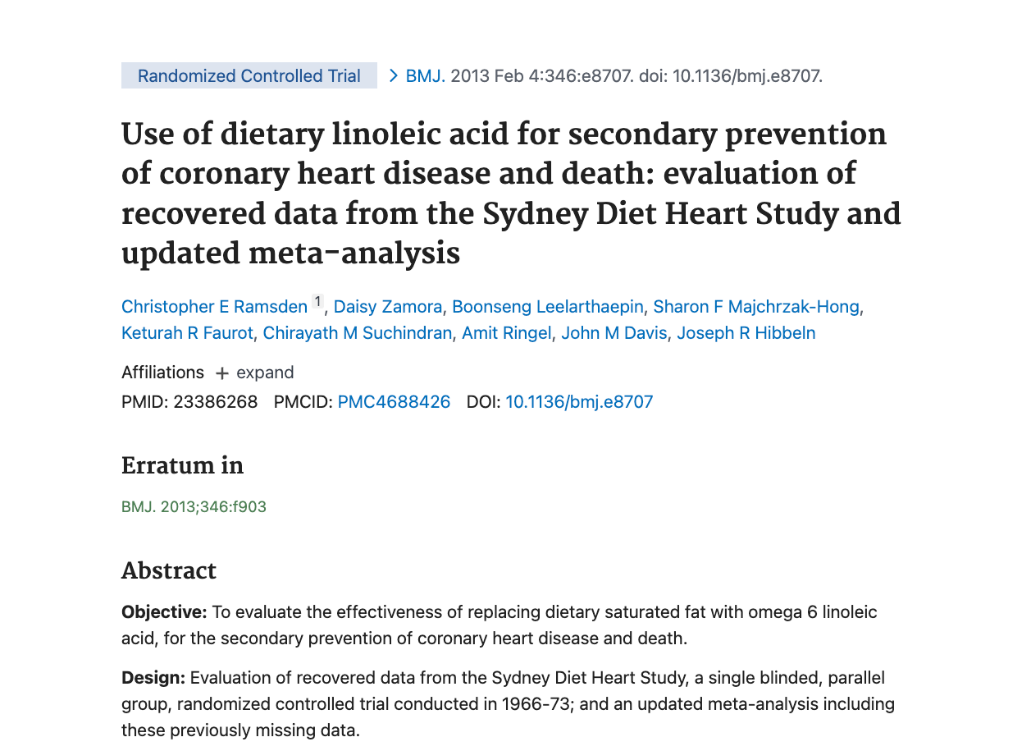
Article Review – Use of Dietary Linoleic Acid for Secondary Prevention of Coronary Heart Disease and Death: Evaluation of Recovered Data from the Sydney Diet Heart Study and Updated Meta-Analysis

Article Review – Use of Dietary Linoleic Acid for Secondary Prevention of Coronary Heart Disease and Death: Evaluation of Recovered Data from the Sydney Diet Heart Study and Updated Meta-Analysis

by Christopher E Ramsden, Daisy Zamora, Boonseng Leelarthaepin, Sharon F Majchrzak-Hong, Keturah R Faurot, Chirayath M Suchindran, Amit Ringel, John M Davis, Joseph R Hibbeln

This article is part of Opti Metabolics’ ongoing effort to translate complex metabolic research into clear, practical insights for readers without formal scientific or medical training.

Summary -

This re-evaluation of the Sydney Diet Heart Study data challenges the long-standing recommendation to replace saturated fats with omega-6-rich seed oils like linoleic acid for heart disease prevention. The findings show that increased linoleic acid intake did not reduce—and may have increased—rates of coronary heart disease and all-cause mortality, raising serious concerns about current dietary fat guidelines.

Key Takeaways Explained for a Non-Medical Audience

– The Sydney Diet Heart Study, a randomized controlled trial conducted between 1966 and 1973, provided rare controlled data on dietary linoleic acid intake and cardiovascular outcomes.

– Recovered and reanalyzed data revealed that participants who increased their intake of linoleic acid through safflower oil had higher rates of death from all causes, cardiovascular disease, and coronary heart disease compared to controls.

– The intervention group replaced saturated fat with linoleic acid without changes in other macronutrients, isolating the effect of linoleic acid itself.

– The findings directly contradict the hypothesis that replacing saturated fat with omega-6 linoleic acid reduces heart disease risk.

– Updated meta-analysis including the recovered data found no evidence of cardiovascular benefit from increasing linoleic acid intake and some indication of harm.

– The mechanism of harm may involve increased oxidative stress, lipid peroxidation, and inflammatory processes promoted by excess omega-6 intake.

– The study emphasizes the need to distinguish between total polyunsaturated fat and omega-6-specific effects in dietary research and guidelines.

– Observational studies that supported omega-6 benefits may have failed to account for confounding dietary factors, such as concurrent reductions in processed carbohydrate or increases in omega-3s.

– Increased omega-6 consumption may impair mitochondrial function and promote lipid instability, contributing to atherosclerosis and arrhythmias.

– The findings question the assumption that all polyunsaturated fats are heart-healthy and highlight the need to reevaluate dietary fat recommendations.

– Safflower oil, used as the primary intervention fat, is extremely high in linoleic acid and low in omega-3s, providing a clear test of omega-6 effects.

– Replacing saturated fat with refined seed oils may increase susceptibility to metabolic and cardiovascular dysfunction, rather than prevent it.

– Public health messaging that uniformly promotes omega-6-rich oils could be contributing to increased chronic disease risk.

– The study supports a more nuanced, whole-food-based approach to fat intake rather than blanket recommendations to reduce saturated fat.

– Balanced intake of omega-3 and omega-6 fatty acids is essential for reducing chronic inflammation and supporting metabolic health.


Integrated Insights –

This analysis underscores a core principle of the Opti Metabolics framework: that not all dietary fats are equal, and excessive omega-6 intake from seed oils can promote metabolic stress and cardiovascular risk. Whole-food sources of fat and reduced consumption of inflammatory seed oils align with improved metabolic resilience and cardiovascular health.

Alignment with Broader Review Content –

– Omega-6-rich seed oils such as safflower oil can increase oxidative stress and promote inflammation, key drivers of metabolic disease.

– Removing saturated fat without considering replacement quality (e.g., replacing with linoleic acid) can worsen metabolic outcomes.

– Low-carbohydrate and whole-food dietary patterns that avoid industrial seed oils better support insulin sensitivity and lipid stability.

Reviewed and interpreted by the Opti Metabolics editorial team, with a focus on early metabolic risk detection and prevention.

Read the article to learn more: Use of Dietary Linoleic Acid for Secondary Prevention of Coronary Heart Disease and Death: Evaluation of Recovered Data from the Sydney Diet Heart Study and Updated Meta-Analysis

Health & Medical Disclaimer –

Opti Metabolics does not provide medical diagnosis, treatment, or advice. Our program is for educational and informational purposes only and does not represent medical advice or the practice of medicine. These article summaries are intended to help readers understand metabolic health research and emerging scientific findings, but personal health decisions should always be made in consultation with a qualified healthcare provider.

Participants are strongly advised to consult their personal healthcare professional before making any dietary, lifestyle, or medication changes.

x
Opti Metabolics provides informational health insights and does not dispense medical advice, diagnose, treat, or cure any medical conditions. Always consult a qualified healthcare professional before making any health-related decisions.

Contact With Us!

Email: info@optimetabolics.com

Join Opti Metabolics

It’s time to take control of your health.

Eat Like a Human Again

Drop your name and email to receive the eBook that shows how returning to simple, whole foods can restore stable energy, support metabolic health, and help your body function the way it was designed to.
Name

The Fast Track to Frailty

Drop your name and email to receive the guide that helps you understand how GLP-1 weight loss changes your body, and why the scale alone never tells the full story.
Name

Starving for Nothing

Drop your name and email to receive the eBook that shows why “Eat Less, Move More” was never your fault. It was the wrong story, and now you get the right one.
Name