Email: success@optimetabolics.com
This article is part of Opti Metabolics’ ongoing effort to translate complex metabolic research into clear, practical insights for readers without formal scientific or medical training.
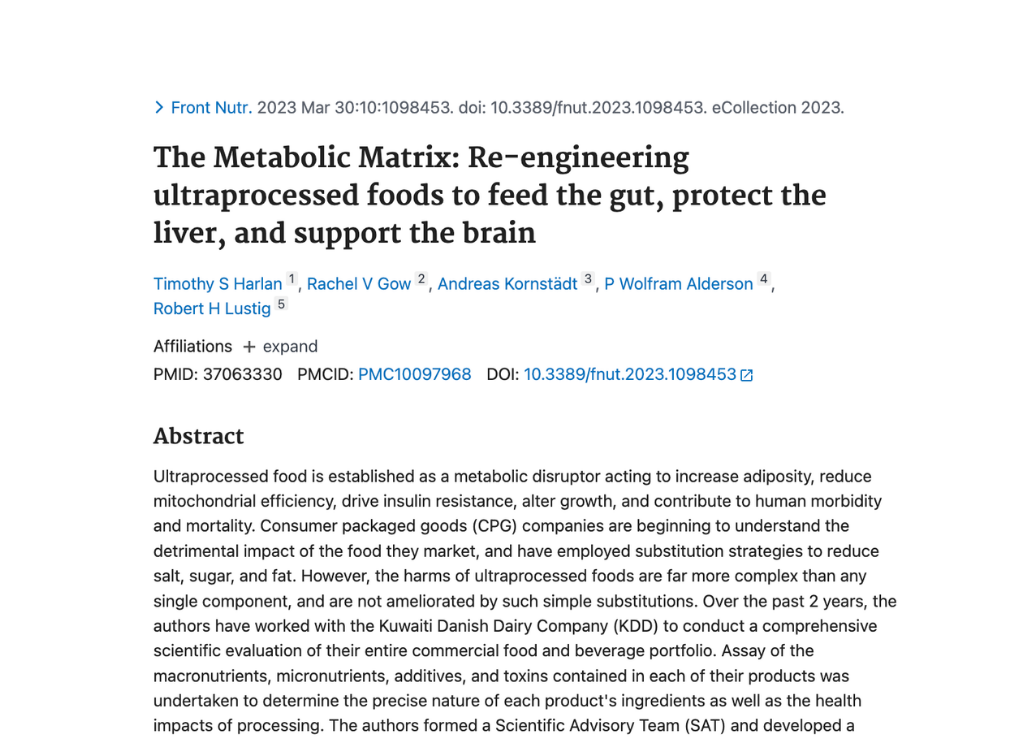
The article introduces the Metabolic Matrix, a framework to reformulate ultraprocessed foods based on three principles—protecting the liver from toxins like fructose, feeding the gut with fiber and prebiotics, and supporting the brain with balanced omega fats—to combat metabolic disruptions such as insulin resistance and mitochondrial dysfunction. Through a collaboration with the Kuwaiti Danish Dairy Company, the authors analyzed 180 products for nutrients, additives, and processing impacts, developing a tiered classification system to guide healthier reformulations while maintaining flavor and economic feasibility. This transferable approach implies significant potential for metabolic health prevention by addressing food quality issues that drive chronic diseases, encouraging industry-wide shifts toward diets that optimize energy regulation and reduce inflammation.
– Ultraprocessed foods are metabolic disruptors that increase adiposity, reduce mitochondrial efficiency, drive insulin resistance, alter growth, and contribute to morbidity and mortality.
– Consumer packaged goods companies have used substitution strategies to reduce salt, sugar, and fat, but these do not fully address the complex harms of ultraprocessed foods.
– The authors conducted a comprehensive evaluation of the Kuwaiti Danish Dairy Company’s 180-item food and beverage portfolio, analyzing macronutrients, micronutrients, additives, and toxins.
– A Scientific Advisory Team was formed to develop a tiered Metabolic Matrix founded on three science-based principles: protect the liver, feed the gut, and support the brain.
– The Metabolic Matrix categorizes products, providing criteria, metrics, and recommendations for improvement or reformulation to enhance health, well-being, and sustainability.
– Chronic metabolic diseases like type 2 diabetes, hypertension, cardiovascular disease, cancer, dementia, and non-alcoholic fatty liver disease are linked to dysfunctional mitochondrial energetics and insulin resistance.
– Common misconceptions include viewing chronic disease as inevitable with aging, obesity as solely due to gluttony and sloth, and equating obesity directly with chronic disease.
– Up to 93% of U.S. adults exhibit some metabolic dysfunction, while quality of ultraprocessed foods, rather than quantity, drives insulin resistance.
– Existing nutrition labeling systems focus on macronutrients and micronutrients but fail to capture full health impacts, leading to the development of the TIERS classification system.
– The Metabolic Matrix pillars emphasize feeding the gut with fiber and prebiotics, protecting the liver from fructose, sugars, toxins, and high glycemic load, and supporting the brain with nutrient-dense foods and healthy fats like omega-3s.
– Phase I of the initiative developed the Metabolic Matrix and TIERS system, involving 38 criteria and extensive data analysis.
– Phase II prioritized actions on sugar, fiber, omega-3s, and emulsifiers, initiating re-engineering for products like chocolate milk and ice cream.
– Ultraprocessed foods contribute to mitochondrial dysfunction, de novo lipogenesis, altered insulin secretion, reduced insulin sensitivity, microbiome changes, and fat cell differentiation.
– Interventions include reducing sugar to one teaspoon per serving, evaluating non-nutritive sweeteners like allulose and stevia, optimizing fiber, and addressing processing and packaging issues.
– The process is transferable as a proof-of-concept, urging other food companies to analyze and reformulate products to improve global metabolic health.
This article aligns with the Opti Metabolics framework by advocating reformulation of ultraprocessed foods to minimize excessive sugars and refined carbohydrates that exacerbate insulin resistance, while promoting fiber-rich, low-glycemic options to enhance gut health and energy management. It connects to metabolic health through emphasis on reducing inflammatory omega-6 imbalances and liver toxins, supporting ketogenic and low-carb strategies to mitigate oxidative stress and chronic inflammation. The Purple Zone principles are embodied in the balanced, evidence-based re-engineering for prevention, prioritizing natural alignments to human biology over processed dietary mismatches.
– Underscores insulin resistance from high-fructose and processed carb intake in ultraprocessed foods, aligning with mitigation via low-carbohydrate reformulations to improve blood sugar control.
– Highlights the inflammatory role of omega-6-rich additives and imbalances, advocating omega-3 enrichment to reduce metabolic stress and chronic disease risks.
– Supports well-formulated, natural-ingredient approaches like fiber optimization and toxin reduction, consistent with ketogenic diets for protecting against non-alcoholic fatty liver disease and oxidative stress.
Reviewed and interpreted by the Opti Metabolics editorial team, with a focus on early metabolic risk detection and prevention.
Read the article to learn more: The Metabolic Matrix: Re-Engineering Ultra Processed Foods to Feed the Gut, Protect the Liver, and Support the Brain
Opti Metabolics does not provide medical diagnosis, treatment, or advice. Our program is for educational and informational purposes only and does not represent medical advice or the practice of medicine. These article summaries are intended to help readers understand metabolic health research and emerging scientific findings, but personal health decisions should always be made in consultation with a qualified healthcare provider.
Participants are strongly advised to consult their personal healthcare professional before making any dietary, lifestyle, or medication changes.
Email: info@optimetabolics.com
It’s time to take control of your health.