Opti Metabolics 11652 Jollyville Road Austin, TX 78759

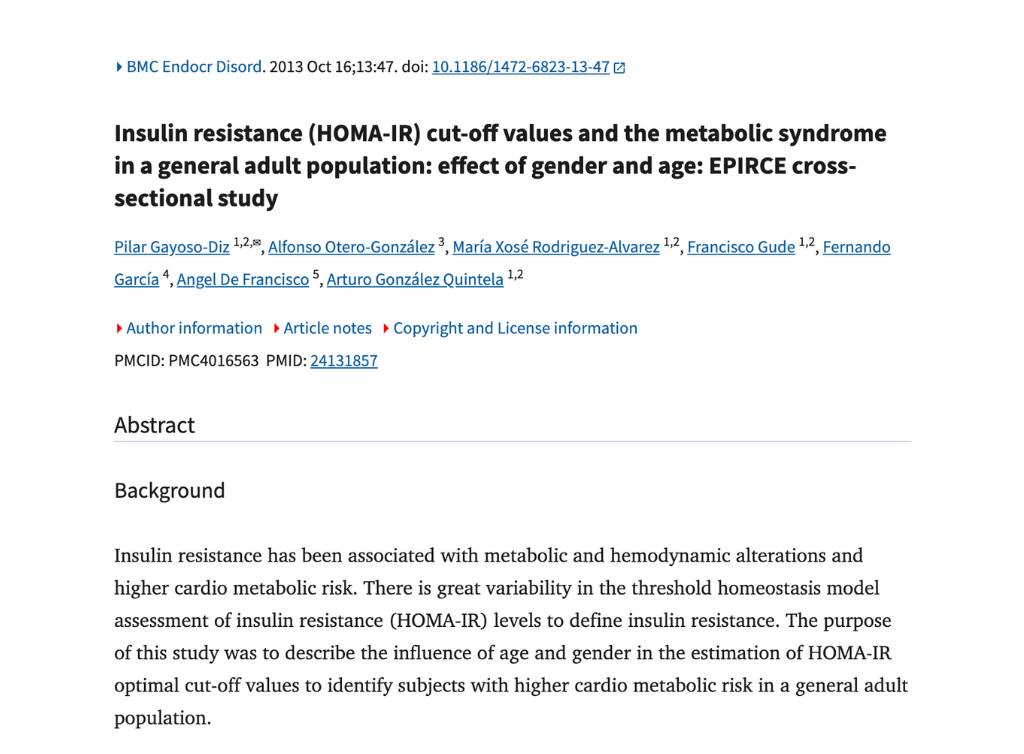
Article Review – Insulin Resistance (HOMA-IR) Cut-Off Values and the Metabolic Syndrome in a General Adult Population: Effect of Gender and Age: EPIRCE Cross-Sectional Study

Article Review – Insulin Resistance (HOMA-IR) Cut-Off Values and the Metabolic Syndrome in a General Adult Population: Effect of Gender and Age: EPIRCE Cross-Sectional Study

by Pilar Gayoso‑Diz, Alfonso Otero‑González, María Xosé Rodriguez‑Alvarez, Francisco Gude, Fernando García, Angel De Francisco, Arturo González Quintela

This article is part of Opti Metabolics’ ongoing effort to translate complex metabolic research into clear, practical insights for readers without formal scientific or medical training.

Summary -

This study defines optimal HOMA‑IR thresholds for identifying individuals at increased cardiometabolic risk, emphasizing the need to adjust values by gender and age rather than relying on population percentiles. Customized cut-offs enhance the clinical utility of HOMA‑IR in detecting metabolic dysfunction early, improving prevention efforts.

Key Takeaways Explained for a Non-Medical Audience

– HOMA‑IR is traditionally interpreted using population percentiles, but this may misidentify individuals at cardiometabolic risk.

– Using metabolic syndrome components to determine HOMA‑IR thresholds provides better predictive accuracy than arbitrary percentiles.

– The study included a broad adult Spanish sample aged 20–92 years to assess optimal HOMA‑IR cut-offs.

– Maximum utility in detecting insulin resistance requires adjusting thresholds by age, especially in non-diabetic women.

– In non-diabetic men, a HOMA‑IR cut-off around 1.85 provided optimal classification for cardiometabolic risk.

– Optimal thresholds align with approximately the 70th to 75th percentiles in the adult Spanish distribution.

– Relying on fixed percentile-based cut-offs overlooks individual variations and demographic influences.

– Age and gender significantly modify the relationship between HOMA‑IR values and metabolic syndrome risk.

– Recognition of these nuances aids in earlier intervention before overt metabolic disease develops.

– Tailored cut-offs improve identification of at-risk individuals, facilitating proactive metabolic health management.

– The study underscores the limitations of one-size-fits-all diagnostic criteria for insulin resistance.

– Clinical assessment of metabolic health benefits from individualized benchmarks rather than generic thresholds.

– Early detection using personalized HOMA‑IR values aligns with prevention-focused metabolic strategies.

– Incorporating minimal-processed nutrition and lifestyle interventions at early detection may halt progression.

– Optimizing HOMA‑IR interpretation bridges the gap between metabolic dysfunction detection and timely intervention.


Integrated Insights –

This article supports the Opti Metabolics emphasis on early, precision-guided detection of insulin resistance by advocating tailored HOMA‑IR thresholds. Being able to identify metabolic dysfunction earlier—especially through individual-specific benchmarks—enhances the efficacy of targeted interventions like low-carbohydrate, anti-inflammatory nutrition to restore metabolic resilience.

Alignment with Broader Review Content –

– Reinforces the need to detect insulin resistance proactively rather than reacting to established disease, aligning with Opti Metabolics’ preventive philosophy.

– Supports nuanced, individualized approaches to metabolic evaluation—much like tailoring low-carb or ketogenic interventions to individual metabolic profiles.

– Enhances practical application of metabolic monitoring, enabling more precise and early dietary and lifestyle corrections based on demographic context.

Reviewed and interpreted by the Opti Metabolics editorial team, with a focus on early metabolic risk detection and prevention.

Read the article to learn more: Insulin Resistance (HOMA-IR) Cut-Off Values and the Metabolic Syndrome in a General Adult Population: Effect of Gender and Age: EPIRCE Cross-Sectional Study

Health & Medical Disclaimer –

Opti Metabolics does not provide medical diagnosis, treatment, or advice. Our program is for educational and informational purposes only and does not represent medical advice or the practice of medicine. These article summaries are intended to help readers understand metabolic health research and emerging scientific findings, but personal health decisions should always be made in consultation with a qualified healthcare provider.

Participants are strongly advised to consult their personal healthcare professional before making any dietary, lifestyle, or medication changes.

x
Opti Metabolics provides informational health insights and does not dispense medical advice, diagnose, treat, or cure any medical conditions. Always consult a qualified healthcare professional before making any health-related decisions.

Contact With Us!

Email: info@optimetabolics.com

Metabolic Snapshot Assessment

Metabolic Snapshot Assessment

Prepared for

Metabolic Marty

Assessment Date

June 2,2026

Identifying Metabolic Risk Before It Becomes Disease

Executive Summary

Your results suggest early signs of metabolic dysfunction are emerging beneath the surface.

While you may feel healthy today, several biomarkers indicate increasing risk for insulin resistance, cardiovascular disease, and other chronic conditions if these patterns continue to progress.

The encouraging news is that these findings were identified before disease developed, creating an opportunity to improve your long-term health trajectory through targeted interventions.

Metabolic Age

20

Metabolic Age

your age

60

Metabolic Age

Years
+ 2 .0

Older than your chronological age

Biomarker risk distrubution

No
Risk

31

Low
Risk

22

Medium Risk

9

High Risk

9

Higher Risk

10

Higher numbers indicate more biomarkers in each risk category.

Your Top Priority areas

See What's Driving Your Risk
Understand how your biomarkers and habits are shaping your future health.
See What's Driving Your Risk
Understand how your biomarkers and habits are shaping your future health.
See What's Driving Your Risk
Understand how your biomarkers and habits are shaping your future health.

The Optic Metabolic Lens

We look upstream to identify and address the root drivers of chronic disease long before symptoms appear.

1. Insulin Resistance

Excess insulin and poor cellular response drive metabolic dycfuntion and fat storage.

2. Oxidative stress

Imbalance between free radicals and your body's antioxidant defenses.

3. Inflamation

Chronic, low grade inflamation damages tissues and disrupts normal function.

4. Stress Physiology

Elevated cortisol and other stress hormones amplify the damaga and impair recovery.

5. Genetic Risk

Inherited factors can increase succeptbility and influence how your body responds.

6. Disease Progression

Over time, these drivers create the foundation for chronic disease to take root.

Eat Like a Human Again

Drop your name and email to receive the eBook that shows how returning to simple, whole foods can restore stable energy, support metabolic health, and help your body function the way it was designed to.
Name

The Fast Track to Frailty

Drop your name and email to receive the guide that helps you understand how GLP-1 weight loss changes your body, and why the scale alone never tells the full story.
Name

Starving for Nothing

Drop your name and email to receive the eBook that shows why “Eat Less, Move More” was never your fault. It was the wrong story, and now you get the right one.
Name