Opti Metabolics 11652 Jollyville Road Austin, TX 78759

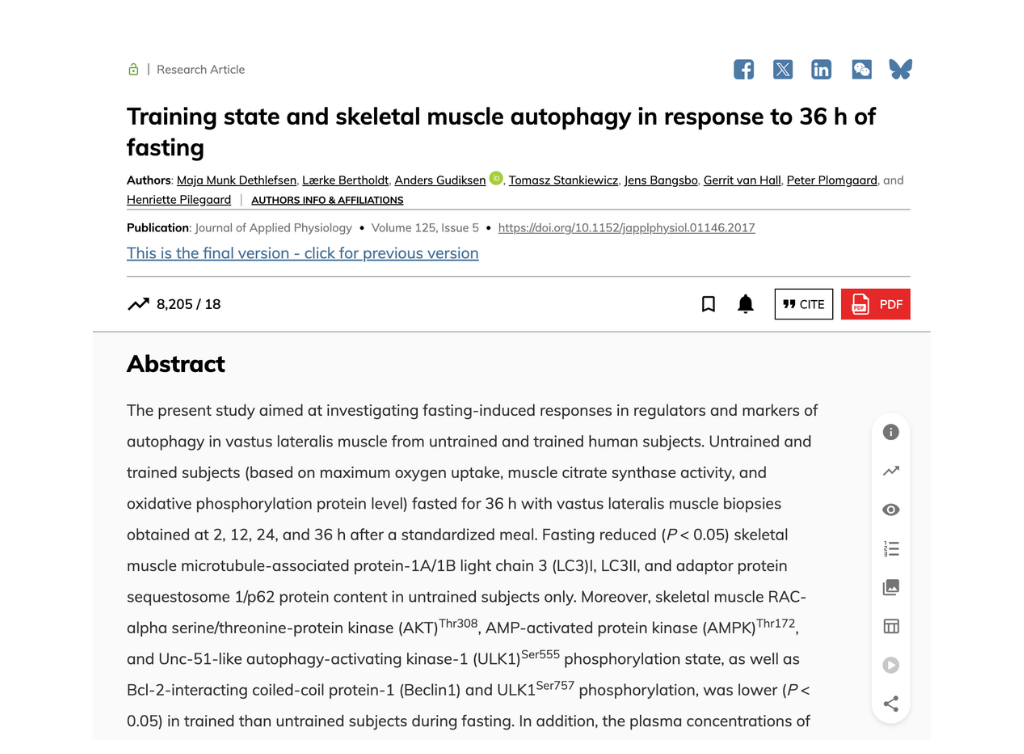
Article Review – Training State and Skeletal Muscle Autophagy in Response to 36 h of Fasting

Article Review – Training State and Skeletal Muscle Autophagy in Response to 36 h of Fasting

by Maja Munk Dethlefsen, Lærke Bertholdt, Anders Gudiksen, Tomasz Stankiewicz, Jens Bangsbo, Gerrit van Hall, Peter Plomgaard, Henriette Pilegaard

This article is part of Opti Metabolics’ ongoing effort to translate complex metabolic research into clear, practical insights for readers without formal scientific or medical training.

Summary -

This study investigates the effects of a 36-hour fast on skeletal muscle autophagy and training state markers. The findings suggest that prolonged fasting activates autophagy pathways in skeletal muscle, enhancing cellular cleanup and metabolic efficiency, which may help improve insulin sensitivity and reduce metabolic stress.

Key Takeaways Explained for a Non-Medical Audience

– A 36-hour fast significantly increases markers of autophagy in skeletal muscle tissue.

– Fasting stimulates the activation of key autophagy-related genes and proteins responsible for cellular repair.

– Enhanced autophagy promotes removal of damaged proteins and organelles, improving muscle cell function.

– Prolonged fasting reduces circulating insulin levels, supporting improved insulin sensitivity.

– Muscle training state markers indicate improved metabolic flexibility following fasting.

– Fasting-induced autophagy may help mitigate oxidative stress within muscle cells.

– Activation of autophagy pathways aligns with reduced inflammation and enhanced metabolic health.

– The study underscores the potential of fasting to complement physical training in metabolic regulation.

– Fasting supports metabolic switching from carbohydrate to fat utilization, enhancing ketogenesis.

– Autophagy activation in skeletal muscle contributes to improved energy efficiency and muscle maintenance.

– Reduced insulin and glucose levels during fasting reduce metabolic strain and oxidative damage.

– The findings support fasting as a natural intervention to improve insulin resistance linked to excessive carbohydrate intake.

– Fasting may counteract the negative effects of omega-6-rich seed oils by lowering inflammatory signaling.

– The interplay between fasting, autophagy, and exercise enhances overall metabolic health outcomes.

– Individual responses may vary, highlighting the need for personalized fasting protocols in metabolic care.


Integrated Insights –

This article reinforces Opti Metabolics’ focus on improving insulin resistance and metabolic health through natural interventions like fasting. Activation of autophagy in muscle tissue supports cellular repair and metabolic flexibility, key for reversing metabolic dysfunction driven by poor diet and inflammation.

Alignment with Broader Review Content –

– Supports fasting and low-carbohydrate dietary approaches to mitigate insulin resistance and metabolic stress.

– Highlights the role of autophagy in reducing oxidative and inflammatory damage linked to omega-6 seed oils.

– Connects exercise and fasting as synergistic strategies for improving metabolic resilience and prevention of chronic disease.

Reviewed and interpreted by the Opti Metabolics editorial team, with a focus on early metabolic risk detection and prevention.

Read the article to learn more: Training State and Skeletal Muscle Autophagy in Response to 36 h of Fasting

Health & Medical Disclaimer –

Opti Metabolics does not provide medical diagnosis, treatment, or advice. Our program is for educational and informational purposes only and does not represent medical advice or the practice of medicine. These article summaries are intended to help readers understand metabolic health research and emerging scientific findings, but personal health decisions should always be made in consultation with a qualified healthcare provider.

Participants are strongly advised to consult their personal healthcare professional before making any dietary, lifestyle, or medication changes.

x
Opti Metabolics provides informational health insights and does not dispense medical advice, diagnose, treat, or cure any medical conditions. Always consult a qualified healthcare professional before making any health-related decisions.

Contact With Us!

Email: info@optimetabolics.com

Metabolic Snapshot Assessment

Metabolic Snapshot Assessment

Prepared for

Metabolic Marty

Assessment Date

June 2,2026

Identifying Metabolic Risk Before It Becomes Disease

Executive Summary

Your results suggest early signs of metabolic dysfunction are emerging beneath the surface.

While you may feel healthy today, several biomarkers indicate increasing risk for insulin resistance, cardiovascular disease, and other chronic conditions if these patterns continue to progress.

The encouraging news is that these findings were identified before disease developed, creating an opportunity to improve your long-term health trajectory through targeted interventions.

Metabolic Age

20

Metabolic Age

your age

60

Metabolic Age

Years
+ 2 .0

Older than your chronological age

Biomarker risk distrubution

No
Risk

31

Low
Risk

22

Medium Risk

9

High Risk

9

Higher Risk

10

Higher numbers indicate more biomarkers in each risk category.

Your Top Priority areas

See What's Driving Your Risk
Understand how your biomarkers and habits are shaping your future health.
See What's Driving Your Risk
Understand how your biomarkers and habits are shaping your future health.
See What's Driving Your Risk
Understand how your biomarkers and habits are shaping your future health.

The Optic Metabolic Lens

We look upstream to identify and address the root drivers of chronic disease long before symptoms appear.

1. Insulin Resistance

Excess insulin and poor cellular response drive metabolic dycfuntion and fat storage.

2. Oxidative stress

Imbalance between free radicals and your body's antioxidant defenses.

3. Inflamation

Chronic, low grade inflamation damages tissues and disrupts normal function.

4. Stress Physiology

Elevated cortisol and other stress hormones amplify the damaga and impair recovery.

5. Genetic Risk

Inherited factors can increase succeptbility and influence how your body responds.

6. Disease Progression

Over time, these drivers create the foundation for chronic disease to take root.

Eat Like a Human Again

Drop your name and email to receive the eBook that shows how returning to simple, whole foods can restore stable energy, support metabolic health, and help your body function the way it was designed to.
Name

The Fast Track to Frailty

Drop your name and email to receive the guide that helps you understand how GLP-1 weight loss changes your body, and why the scale alone never tells the full story.
Name

Starving for Nothing

Drop your name and email to receive the eBook that shows why “Eat Less, Move More” was never your fault. It was the wrong story, and now you get the right one.
Name