



Email: success@optimetabolics.com
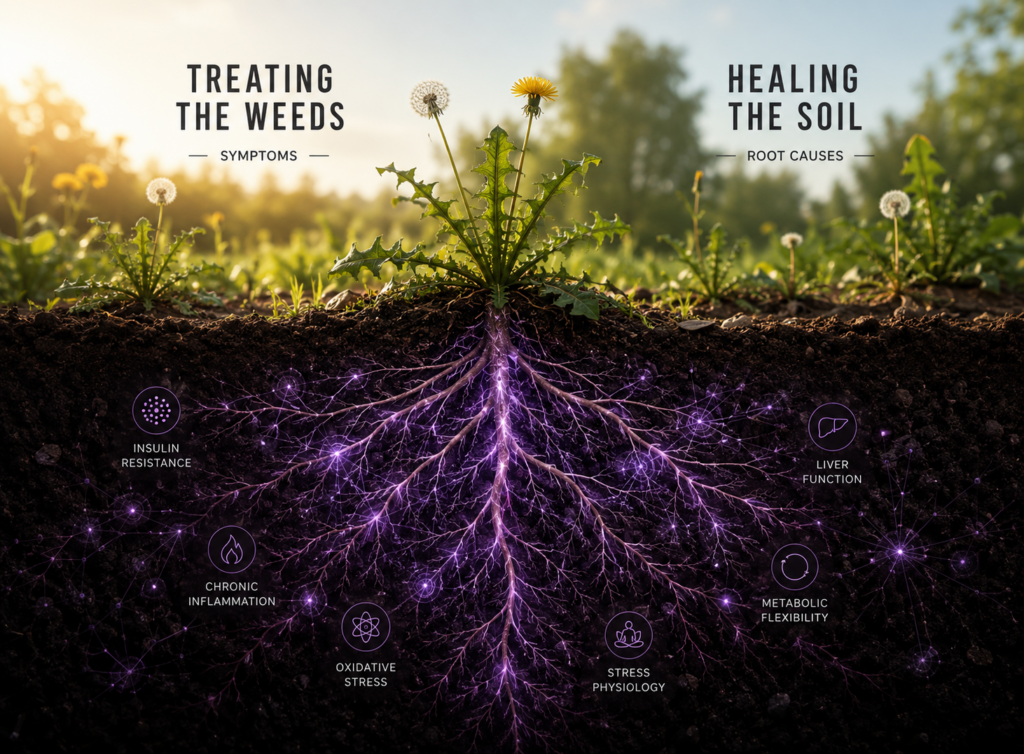
Walk into an overgrown garden and you’ll notice the weeds first. You could spend the afternoon pulling every one of them. The garden would certainly look better, at least for a while. But come back a week later, and chances are many of those weeds have returned. Why?
Because the real problem was never the weeds. It was the soil.
Now ask yourself a different question: What if we’ve been approaching human health the same way?
For decades, modern healthcare has become exceptionally skilled at identifying disease once it has arrived. High blood sugar. Elevated cholesterol. High blood pressure. Excess weight. Fatty liver disease. These are important findings, and treating them has undoubtedly saved lives.
But what if many of these conditions are better understood as the weeds rather than the soil?
Most chronic diseases don’t appear overnight. Heart disease develops over decades. Type 2 diabetes typically begins with years of worsening insulin resistance before blood sugar ever crosses the diagnostic threshold. Fatty liver disease, cognitive decline, and many other chronic illnesses often spend years quietly developing beneath the surface before symptoms finally demand attention.
By the time many people receive a diagnosis, their biology has already been moving in that direction for years. So what was happening before the diagnosis? That’s often where the most valuable information lives.
Imagine two homeowners with identical gardens filled with weeds. One spends every weekend pulling weeds. The other improves the soil: better nutrients, healthier microorganisms, proper watering, stronger root systems.
Months later, which garden requires less work? Health works remarkably similarly.
Many people understandably focus on what they can easily see:
Those things matter. But they don’t always explain why your body is behaving the way it is. At Opti, we’re interested in asking the next question. What’s happening underneath?
Your metabolism leaves clues long before disease develops. Instead of looking only at surface-level outcomes, we focus on the biological environment that allows chronic disease to grow. Some of the most important underlying drivers include:
Insulin resistance often develops years before Type 2 diabetes is diagnosed. During this time, fasting glucose may still appear “normal” while the body quietly requires increasing amounts of insulin to keep blood sugar under control. This compensation can mask metabolic dysfunction for years.
Inflammation is a critical part of healing. Chronic, low-grade inflammation is different. When inflammation remains elevated over long periods, it has been associated with cardiovascular disease, diabetes, neurodegenerative disease, and numerous other chronic conditions. Often, there are no obvious symptoms during the early stages.
Every cell produces energy, but energy production also creates oxidative byproducts. When oxidative stress exceeds the body’s ability to neutralize it, cellular structures (including proteins, fats, and DNA) can become damaged. Researchers continue to study oxidative stress as a common contributor across many chronic diseases and the aging process.
Stress isn’t inherently bad. The problem comes when stress hormones remain elevated for months or years without adequate recovery. Persistent activation of the stress response can influence blood sugar regulation, inflammation, sleep quality, appetite, and overall metabolic health.
The liver helps regulate glucose, cholesterol, hormones, detoxification pathways, and energy metabolism. Even subtle changes in liver health can influence metabolic function long before significant liver disease develops.
Healthy metabolism isn’t simply about burning calories. It’s about your body’s ability to efficiently switch between carbohydrates and fat for fuel depending on what your body needs. Losing this flexibility may contribute to fatigue, cravings, unstable energy, and worsening metabolic health over time.
One of the most encouraging realities in metabolic health is this: Many of these underlying patterns are measurable long before disease develops. That doesn’t mean a biomarker predicts your future with certainty. It means your biology may already be offering valuable clues.
When people understand these patterns earlier, they often have greater opportunities to improve nutrition, increase physical activity, prioritize recovery, improve sleep, reduce chronic stress, and work with their healthcare team before problems become significantly more advanced.
That’s a fundamentally different philosophy than simply waiting until disease appears.
One of the biggest shifts we hope people make isn’t simply learning more biomarkers. It’s learning to ask better questions.
Instead of asking: “Is this lab value normal?” Consider asking:
Those questions often lead to far more meaningful conversations with your healthcare provider than focusing on any single laboratory number in isolation. Because health isn’t simply the absence of disease. It’s the condition of the soil from which long-term health grows.
This only scratches the surface of the science behind metabolic health. Opti Metabolics members receive significantly deeper educational resources exploring insulin resistance, inflammation, oxidative stress, biomarker interpretation, and the interconnected biological patterns that influence long-term health.
If you’re ready to understand what your own biomarkers may already be revealing, start by uploading your recent lab work to our complimentary Metabolic Discovery Snapshot. You’ll receive a personalized educational overview of your metabolic patterns and discover how an Opti Membership can provide ongoing research, coaching, and exclusive educational content designed to help you better understand your health before disease develops.
Email: info@optimetabolics.com
Your results suggest early signs of metabolic dysfunction are emerging beneath the surface.
While you may feel healthy today, several biomarkers indicate increasing risk for insulin resistance, cardiovascular disease, and other chronic conditions if these patterns continue to progress.
The encouraging news is that these findings were identified before disease developed, creating an opportunity to improve your long-term health trajectory through targeted interventions.
No
Risk
Low
Risk
Medium Risk
High Risk
Higher Risk
Higher numbers indicate more biomarkers in each risk category.
We look upstream to identify and address the root drivers of chronic disease long before symptoms appear.
Excess insulin and poor cellular response drive metabolic dycfuntion and fat storage.
Imbalance between free radicals and your body's antioxidant defenses.
Chronic, low grade inflamation damages tissues and disrupts normal function.
Elevated cortisol and other stress hormones amplify the damaga and impair recovery.
Inherited factors can increase succeptbility and influence how your body responds.
Over time, these drivers create the foundation for chronic disease to take root.