



Email: success@optimetabolics.com
Most people have never heard of GGT until those three letters appear on routine bloodwork.
Gamma-glutamyl transferase is usually treated as a liver enzyme. If it falls within the laboratory’s reference range, the conversation often ends there.
This is where the conversation starts, because GGT may be telling you much more than whether your liver is “normal.”
It may be telling you how hard your body’s antioxidant defense system is working, how much oxidative stress your metabolism is generating, and whether repeated blood sugar spikes are quietly creating damage long before your A1c or fasting glucose ever becomes abnormal. That is a much bigger story.
Your body has one of the most powerful antioxidant systems in biology built directly into it: glutathione. You do not buy it. You make it.
Glutathione acts like an internal cleanup crew, working around the clock to neutralize oxidative stress generated by normal metabolism, inflammation, environmental exposures, blood sugar fluctuations, and other sources of cellular damage.
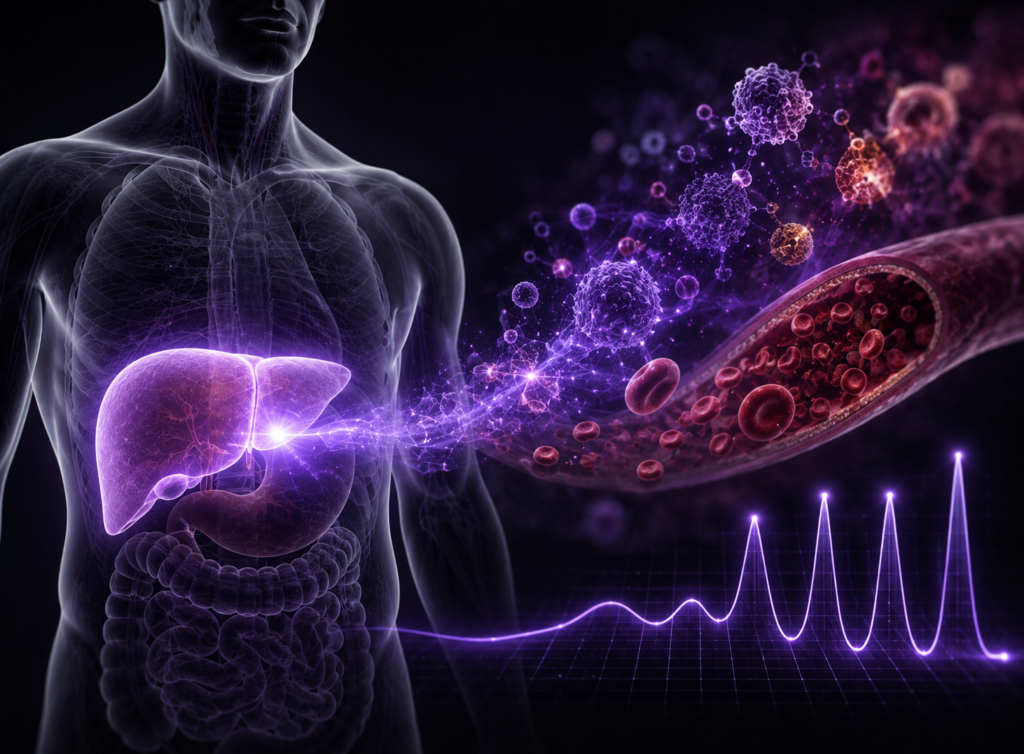
GGT is closely connected to that glutathione system. When the body is under increasing oxidative stress and glutathione is being used faster than it can be replenished, GGT can begin to rise. That means a rising GGT should not automatically be viewed only as a liver story. It can also function as a warning light that the body’s antioxidant defenses are being pushed harder.
The next question becomes: What is creating that oxidative stress in the first place?
One of the most common metabolic stressors is something people experience multiple times every day: a blood sugar spike.
Every time carbohydrates are eaten, glucose rises. That is normal. But when glucose repeatedly climbs too high after meals, the metabolic consequences can look very different.
Once glucose rises above approximately 140 mg/dL, it moves beyond the upper end of what is considered a normal post-meal response. Those larger glucose excursions can increase oxidative stress, forcing the body’s antioxidant systems, including glutathione, to work harder.
Do that once, and the body can usually handle it. Do it three or four times a day, every day, for years? Now there is a different metabolic environment entirely. And this is where one of the most commonly used blood sugar tests can miss the story.
Hemoglobin A1c is useful. But it is still an average. It reflects average glucose exposure over roughly three months. What it does not show is what happened after breakfast, lunch, dinner, dessert, or that afternoon sweetened coffee.
A person could repeatedly spike above 140 mg/dL after meals and still maintain an A1c that appears acceptable. The average looks fine. The excursions disappear.
Put a continuous glucose monitor on that same person, and suddenly the metabolic movie becomes much easier to see. It does not benefit you to simply ask whether glucose is “normal.”
The better question is: What is glucose doing throughout the day, and what is that pattern doing to the rest of the body?
The goal is not merely to stay below the diabetic range. The goal is to create a glucose pattern that places less metabolic stress on the body.
A strong post-meal glucose response generally looks like this:
Those targets are more aggressive than simply asking whether glucose is “high.” That is intentional. The objective is not merely to avoid a diagnosis. It is to reduce the repeated oxidative stress that can accompany large glucose excursions and preserve the body’s antioxidant reserve before dysfunction becomes obvious.
This is where GGT becomes especially interesting. Many laboratory reports will not flag GGT as high until it reaches 50, 60, or even 70 U/L, depending on the laboratory and the individual. But that range was built primarily around identifying liver disease.
It was not designed to tell you whether your metabolic and antioxidant systems are functioning optimally. When GGT is viewed through a metabolic lens, a very different picture emerges.
Large population studies involving more than half a million people have found that cardiovascular risk rises progressively as GGT increases, including across values that would still be called “normal” on many laboratory reports.
In one major meta-analysis, every 10 U/L increase in GGT was associated with roughly a 10% increase in cardiovascular mortality risk.
And the healthiest, lowest-risk metabolic profiles are often found at values around the low teens: ~ 14 U/L.
That is a very different message from: “You’re under 50. Everything looks fine.”
The target is not simply to stay below the laboratory’s upper limit. The goal is to understand why GGT is moving, what metabolic forces may be driving it, and whether the body’s antioxidant defenses are being asked to work harder than they should.
This is also why GGT should not be viewed in isolation. Repeated blood sugar spikes can increase oxidative stress. Oxidative stress increases demand on glutathione. GGT reflects activity within that glutathione system. And increased oxidative stress can damage LDL particles, contributing to the same biological processes involved in plaque formation and cardiovascular disease.
Those are not separate conversations. They are connected. That is the larger metabolic picture many routine laboratory reviews miss.
GGT, glucose, triglycerides, HDL cholesterol, uric acid, liver enzymes, inflammation, insulin resistance, and cardiovascular risk are not independent numbers living on separate lines of a laboratory report. They are part of the same biological system.
A normal laboratory result can still contain valuable information. That is one of the central ideas behind the Opti Metabolic Lens.
Rather than stopping at: “Is GGT within range?”
Opti Metabolics asks:
Those questions create a much richer picture of metabolic health. Because sometimes the most overlooked number on your laboratory report is also one of the most revealing.
GGT is only one example of how a standard laboratory result can reveal far more when viewed through a metabolic lens.
Opti Metabolics members receive much deeper educational content on GGT, glutathione, oxidative stress, blood sugar variability, insulin resistance, cardiovascular risk, and the relationships between biomarkers that traditional lab reviews often consider separately.
If you’ve had blood work completed within the past year, upload your labs to our complimentary Metabolic Discovery Snapshot. Opti Metabolics will evaluate those results through the Opti Metabolic Lens and help identify the patterns developing beneath the surface.
From there, Opti Membership provides access to deeper research, exclusive educational resources, expert coaching, and ongoing metabolic insights designed to help you understand what your body is telling you while there is still time to change the trajectory.
Opti Metabolics does not provide medical diagnosis, treatment, or advice. Our program is for educational and informational purposes only and does not represent medical advice or the practice of medicine. Participants are strongly advised to consult their personal healthcare professional before making any dietary, lifestyle, or medication changes.
Email: info@optimetabolics.com
Your results suggest early signs of metabolic dysfunction are emerging beneath the surface.
While you may feel healthy today, several biomarkers indicate increasing risk for insulin resistance, cardiovascular disease, and other chronic conditions if these patterns continue to progress.
The encouraging news is that these findings were identified before disease developed, creating an opportunity to improve your long-term health trajectory through targeted interventions.
No
Risk
Low
Risk
Medium Risk
High Risk
Higher Risk
Higher numbers indicate more biomarkers in each risk category.
We look upstream to identify and address the root drivers of chronic disease long before symptoms appear.
Excess insulin and poor cellular response drive metabolic dycfuntion and fat storage.
Imbalance between free radicals and your body's antioxidant defenses.
Chronic, low grade inflamation damages tissues and disrupts normal function.
Elevated cortisol and other stress hormones amplify the damaga and impair recovery.
Inherited factors can increase succeptbility and influence how your body responds.
Over time, these drivers create the foundation for chronic disease to take root.