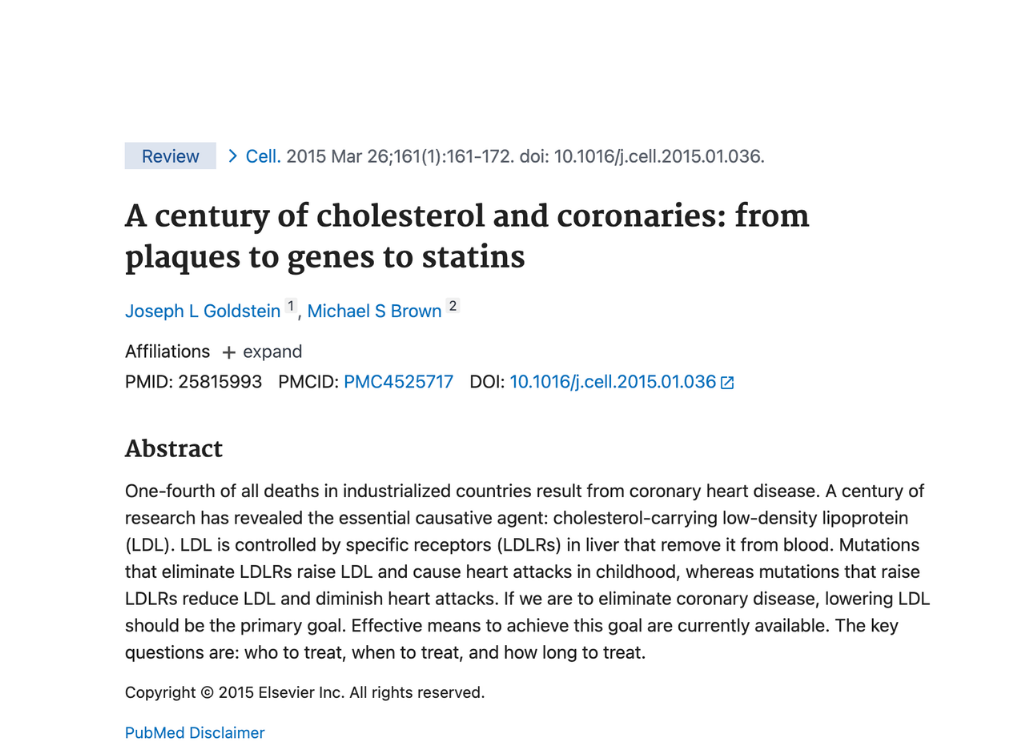
Article Review – A Century of Cholesterol and Coronaries: From Plaques to Genes and Statins

Article Review – A Century of Cholesterol and Coronaries: From Plaques to Genes and Statins

by Joseph L. Goldstein, Michael S. Brown

This article is part of Opti Metabolics’ ongoing effort to translate complex metabolic research into clear, practical insights for readers without formal scientific or medical training.

Summary -

This article reviews a century of research linking cholesterol, particularly in the form of low-density lipoprotein, to coronary heart disease, tracing discoveries from cholesterol accumulation in arterial plaques to genetic regulators of cholesterol metabolism and the development of statins as effective treatments. It emphasizes LDL’s causative role in atherosclerosis, with implications for metabolic health suggesting that lifelong management of LDL levels through diet, lifestyle, and pharmaceuticals can prevent heart attacks by reducing plaque formation and inflammation. By highlighting dietary fats’ influence on LDL, the piece underscores opportunities for prevention via metabolic optimization to enhance the body’s natural regulatory mechanisms.

Key Takeaways Explained for a Non-Medical Audience

– One-fourth of all deaths in industrialized countries result from coronary heart disease, primarily caused by cholesterol-carrying low-density lipoprotein.

– LDL levels are regulated by liver-specific LDL receptors, and genetic mutations can dramatically alter these levels, leading to early heart attacks or protection against them.

– The ultimate goal in eliminating coronary heart disease is to lower LDL levels, with effective methods now available, though questions remain on treatment timing and duration.

– Coronary heart disease arises from atherosclerotic plaques blocking arteries, a condition clinically recognized about 100 years ago with rising incidence followed by recent declines in some regions.

– Multidisciplinary evidence from pathology, biochemistry, genetics, and clinical trials implicates LDL as the primary instigator of plaques.

– High dietary fat intake, especially saturated fats, is a major contributor to elevated LDL levels in humans.

– In 1910, atherosclerotic plaques were found to contain 25 times more cholesterol than normal arterial tissue.

– Feeding rabbits pure cholesterol in 1913 induced atherosclerosis, suggesting dietary cholesterol’s role in plaque formation.

– Electrocardiograms enabled diagnosis of nonfatal heart attacks in 1919, advancing clinical understanding.

– Feedback inhibition of cholesterol synthesis by dietary cholesterol was demonstrated in 1933, laying groundwork for metabolic regulation insights.

– Familial hypercholesterolemia was described in 1938 as an inherited condition with high cholesterol and increased heart attack risk.

– The cholesterol biosynthetic pathway was elucidated in the 1950s, identifying HMG CoA reductase as the rate-limiting enzyme.

– The Seven Countries Study in 1953 linked dietary fat consumption to serum cholesterol levels and coronary events across populations.

– LDL was identified in 1955 as a major risk factor for coronary heart disease using ultracentrifugation techniques.

– The LDL receptor was discovered in 1973 through studies of familial hypercholesterolemia patients.

– Statins, inhibitors of HMG CoA reductase, were discovered in 1976 and first approved in 1987, later proven in 1994 to reduce heart attacks and extend life.


Integrated Insights –

This article’s focus on LDL as a driver of atherosclerosis aligns with Opti Metabolics by illustrating how dysregulated lipid metabolism contributes to chronic disease, often compounded by insulin resistance from excessive carbohydrate intake. Low-carbohydrate or ketogenic approaches can support metabolic health by reducing inflammation and optimizing energy management, potentially complementing LDL-lowering strategies like statins. Emphasizing natural, well-formulated diets echoes the framework’s principles for mitigating metabolic stress and promoting long-term prevention.

Alignment with Broader Review Content –

– Reinforces the connection between lipid profiles, such as elevated LDL, and atherosclerotic cardiovascular disease, integrating with discussions on insulin resistance as an underlying factor in plaque progression.

– Highlights genetic and dietary influences on cholesterol metabolism, paralleling reviews of oxidative stress and inflammatory responses driven by poor metabolic health.

– Supports the role of targeted interventions like statins in lipid management, while aligning with lifestyle modifications to address cortisol-mediated stresses and improve overall glycemic control.

Reviewed and interpreted by the Opti Metabolics editorial team, with a focus on early metabolic risk detection and prevention.

Read the article to learn more: A Century of Cholesterol and Coronaries: From Plaques to Genes and Statins

Health & Medical Disclaimer –

Opti Metabolics does not provide medical diagnosis, treatment, or advice. Our program is for educational and informational purposes only and does not represent medical advice or the practice of medicine. These article summaries are intended to help readers understand metabolic health research and emerging scientific findings, but personal health decisions should always be made in consultation with a qualified healthcare provider.

Participants are strongly advised to consult their personal healthcare professional before making any dietary, lifestyle, or medication changes.

x
Opti Metabolics provides informational health insights and does not dispense medical advice, diagnose, treat, or cure any medical conditions. Always consult a qualified healthcare professional before making any health-related decisions.

Contact With Us!

Email: info@optimetabolics.com

Join Opti Metabolics

It’s time to take control of your health.

Eat Like a Human Again

Drop your name and email to receive the eBook that shows how returning to simple, whole foods can restore stable energy, support metabolic health, and help your body function the way it was designed to.
Name

The Fast Track to Frailty

Drop your name and email to receive the guide that helps you understand how GLP-1 weight loss changes your body, and why the scale alone never tells the full story.
Name

Starving for Nothing

Drop your name and email to receive the eBook that shows why “Eat Less, Move More” was never your fault. It was the wrong story, and now you get the right one.
Name