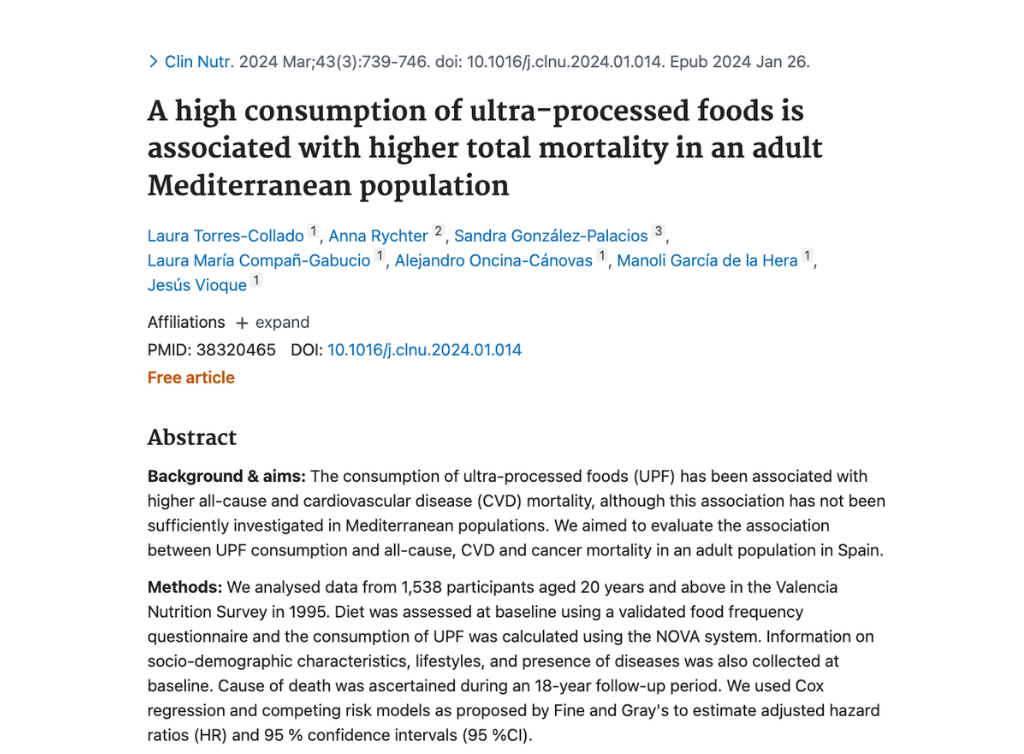
Article Review – A High Consumption of Ultra-Processed Foods is Associated with Higher Total Mortality in an Adult Mediterranean Population

Article Review – A High Consumption of Ultra-Processed Foods is Associated with Higher Total Mortality in an Adult Mediterranean Population

by Laura Torres-Collado, Anna Rychter, Sandra González-Palacios, Laura María Compañ-Gabucio, Alejandro Oncina-Cánovas, Manoli García de la Hera, Jesús Vioque

This article is part of Opti Metabolics’ ongoing effort to translate complex metabolic research into clear, practical insights for readers without formal scientific or medical training.

Summary -

This study demonstrates that higher consumption of ultra-processed foods is linked to increased all-cause mortality in a Mediterranean adult population, with trends toward higher cardiovascular and cancer mortality risks over an 18-year follow-up. The findings underscore the detrimental health effects of ultra-processed foods, which often contain high levels of refined carbohydrates and inflammatory additives. For metabolic health and prevention, reducing ultra-processed food intake in favor of natural, low-carbohydrate diets can help mitigate insulin resistance and inflammation, potentially lowering risks of chronic diseases like cardiovascular conditions and cancer.

Key Takeaways Explained for a Non-Medical Audience

– The study analyzed data from 1,538 participants aged 20 years and above from the Valencia Nutrition Survey in 1995.

– Dietary intake was assessed using a validated food frequency questionnaire, with ultra-processed food consumption classified via the NOVA system.

– Participants were followed for 18 years, during which 312 deaths occurred, including 36.5 percent from cardiovascular disease and 25.6 percent from cancer.

– Ultra-processed food intake was divided into tertiles for analysis, comparing highest to lowest consumption groups.

– The highest tertile of ultra-processed food consumption was associated with a 40 percent increased risk of all-cause mortality, with a hazard ratio of 1.40 and 95 percent confidence interval of 1.04 to 1.90.

– There was a trend toward higher cardiovascular disease mortality in the highest tertile, with a hazard ratio of 1.39 and 95 percent confidence interval of 0.80 to 2.41.

– Cancer mortality showed a similar trend, with a hazard ratio of 1.53 and 95 percent confidence interval of 0.83 to 2.82.

– Statistical models used Cox regression and Fine and Gray’s competing risk approaches, adjusted for sociodemographic factors, lifestyles, and baseline diseases.

– The association persisted after adjustments, suggesting ultra-processed foods independently contribute to mortality risks.

– Ultra-processed foods in the study included items like sugary drinks, processed meats, and packaged snacks, often high in additives and low in nutrients.

– The Mediterranean population traditionally follows protective diets, but increasing ultra-processed food intake may erode these benefits.

– No significant subgroup analyses were detailed, but the overall findings held across the adult cohort.

– The study calls for further research to confirm these associations in other populations given rising ultra-processed food consumption globally.

– Results align with prior evidence linking ultra-processed foods to adverse health outcomes, emphasizing the need for dietary guidelines to limit them.

– Limitations include potential residual confounding and reliance on baseline dietary data without repeated assessments.


Integrated Insights –

This article supports the Opti Metabolics framework by illustrating how ultra-processed foods, rich in refined carbohydrates and omega-6 seed oils, drive insulin resistance and chronic inflammation, contributing to higher mortality from metabolic-related conditions. Shifting to well-formulated low-carbohydrate or ketogenic diets with natural ingredients can counteract these effects by improving blood sugar management and reducing oxidative stress. These dietary changes offer preventive strategies against the systemic metabolic disruptions highlighted in the study.

Alignment with Broader Review Content –

– Reinforces the role of lifestyle risks like ultra-processed food consumption in elevating insulin resistance and oxidative stress, similar to links in diabetes and non-alcoholic fatty liver disease.

– Connects high ultra-processed food intake to cardiovascular and cancer risks, aligning with discussions on how low-carb diets mitigate inflammation and metabolic stressors in these conditions.

– Highlights dietary patterns as underlying contributors to chronic diseases, consistent with content on ketogenic approaches reducing all-cause mortality through better lipid profiles and glycemic control.

Reviewed and interpreted by the Opti Metabolics editorial team, with a focus on early metabolic risk detection and prevention.

Read the article to learn more: A High Consumption of Ultra-Processed Foods is Associated with Higher Total Mortality in an Adult Mediterranean Population

Health & Medical Disclaimer –

Opti Metabolics does not provide medical diagnosis, treatment, or advice. Our program is for educational and informational purposes only and does not represent medical advice or the practice of medicine. These article summaries are intended to help readers understand metabolic health research and emerging scientific findings, but personal health decisions should always be made in consultation with a qualified healthcare provider.

Participants are strongly advised to consult their personal healthcare professional before making any dietary, lifestyle, or medication changes.

x
Opti Metabolics provides informational health insights and does not dispense medical advice, diagnose, treat, or cure any medical conditions. Always consult a qualified healthcare professional before making any health-related decisions.

Contact With Us!

Email: info@optimetabolics.com

Join Opti Metabolics

It’s time to take control of your health.

Eat Like a Human Again

Drop your name and email to receive the eBook that shows how returning to simple, whole foods can restore stable energy, support metabolic health, and help your body function the way it was designed to.
Name

The Fast Track to Frailty

Drop your name and email to receive the guide that helps you understand how GLP-1 weight loss changes your body, and why the scale alone never tells the full story.
Name

Starving for Nothing

Drop your name and email to receive the eBook that shows why “Eat Less, Move More” was never your fault. It was the wrong story, and now you get the right one.
Name