Email: success@optimetabolics.com
This article is part of Opti Metabolics’ ongoing effort to translate complex metabolic research into clear, practical insights for readers without formal scientific or medical training.
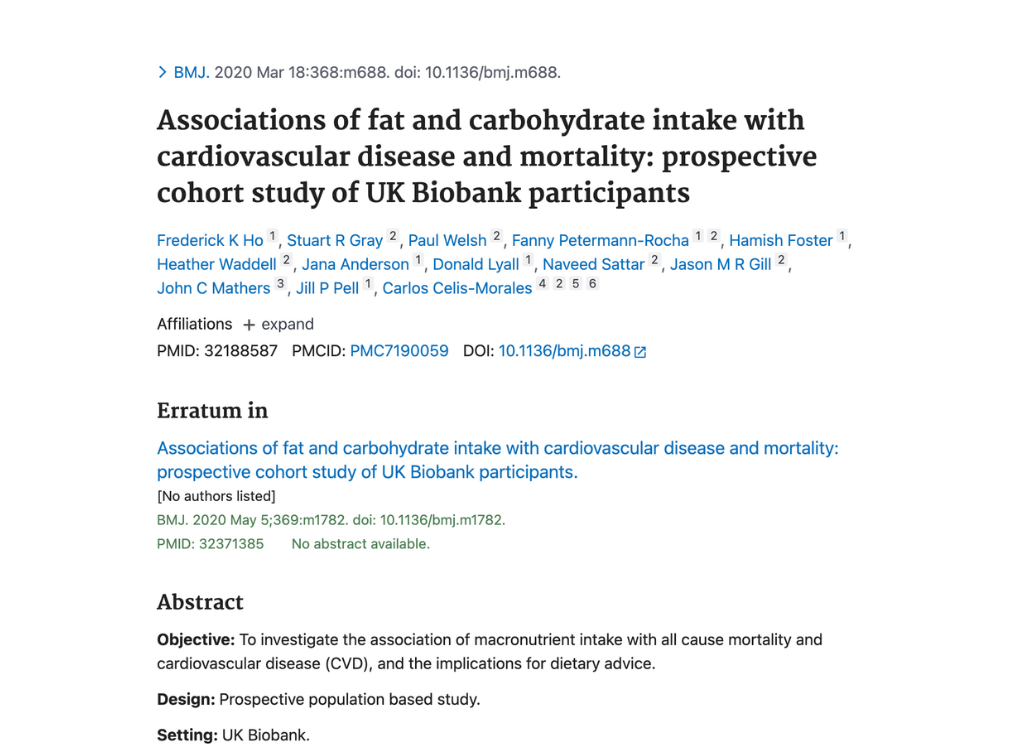
This prospective cohort study from the UK Biobank reveals non-linear associations between macronutrient intakes and risks of cardiovascular disease and all-cause mortality, emphasizing that higher carbohydrate consumption above 50 percent of total energy is linked to increased mortality while specific fat profiles offer protective effects. Optimal intakes include higher monounsaturated fats and lower saturated and polyunsaturated fats, suggesting personalized dietary strategies over uniform guidelines. These insights support metabolic health by advocating reduced carbohydrate loads to combat insulin resistance and inflammation, aligning with low-carbohydrate or ketogenic approaches for disease prevention.
– The study analyzed data from 195,658 UK Biobank participants aged 37-73 who completed at least one 24-hour dietary recall.
– Over a mean follow-up of 10.6 years for mortality and 9.7 years for CVD, there were 4,780 deaths and 10,724 CVD events.
– Carbohydrate intake showed a non-linear association with mortality, with no link at 20-50 percent of energy but a positive association at 50-70 percent (average HR 1.14 for 60-70 percent vs. 50 percent).
– Sugar intake mirrored the pattern for total carbohydrates, showing increased mortality risk at higher levels.
– Starch and fibre intakes did not exhibit significant associations with mortality.
– Higher monounsaturated fat intake (20-25 percent vs. 5 percent of energy) was associated with lower mortality (average HR 0.58).
– Lower polyunsaturated fat intake (5-7 percent vs. 12 percent of energy) correlated with reduced mortality (average HR 0.78).
– Lower saturated fat intake (5-10 percent vs. 20 percent of energy) was linked to lower mortality (average HR 0.67).
– For CVD, total carbohydrate and sugar showed linear positive associations, while fibre, polyunsaturated fats, and protein had non-linear links.
– Lower sugar intake (5-20 percent vs. 35 percent of energy) reduced CVD risk (average HR 0.83).
– Higher monounsaturated fats and lower polyunsaturated fats were associated with decreased CVD incidence.
– Isocaloric replacement of sugar with starch, monounsaturated fats, or protein was linked to lower mortality and CVD risks.
– Replacing saturated fats with monounsaturated fats or protein also reduced risks.
– A dietary risk matrix identified lowest mortality with high fibre (10-30 g/day), protein (14-30 percent), monounsaturated fats (20-35 percent), low sugar (<10 percent), moderate starch (20-40 percent), low saturated fats (<10 percent), and polyunsaturated fats (4-8 percent).
This article connects to metabolic health by demonstrating how excessive carbohydrates fuel insulin resistance and metabolic dysfunction, core issues in the Opti Metabolics framework. It reinforces the benefits of low-carbohydrate diets in optimizing energy management and reducing inflammation from poor fat choices. Overall, the findings advocate for ketogenic or low-carb strategies using natural ingredients to prevent chronic diseases.
– Reinforces that insulin resistance from high carbohydrate intake drives cardiovascular risks, mitigated by low-carb approaches.
– Highlights the inflammatory role of certain fats like polyunsaturated ones rich in omega-6, aligning with cautions on seed oils.
– Supports personalized, natural-ingredient diets to improve metabolic markers and prevent mortality.
Reviewed and interpreted by the Opti Metabolics editorial team, with a focus on early metabolic risk detection and prevention.
Read the article to learn more: Associations of Fat and Carbohydrate Intake with Cardiovascular Disease and Mortality: Prospective Cohort Study of UK Biobank Participants
Opti Metabolics does not provide medical diagnosis, treatment, or advice. Our program is for educational and informational purposes only and does not represent medical advice or the practice of medicine. These article summaries are intended to help readers understand metabolic health research and emerging scientific findings, but personal health decisions should always be made in consultation with a qualified healthcare provider.
Participants are strongly advised to consult their personal healthcare professional before making any dietary, lifestyle, or medication changes.
Tags:
Email: info@optimetabolics.com
It’s time to take control of your health.