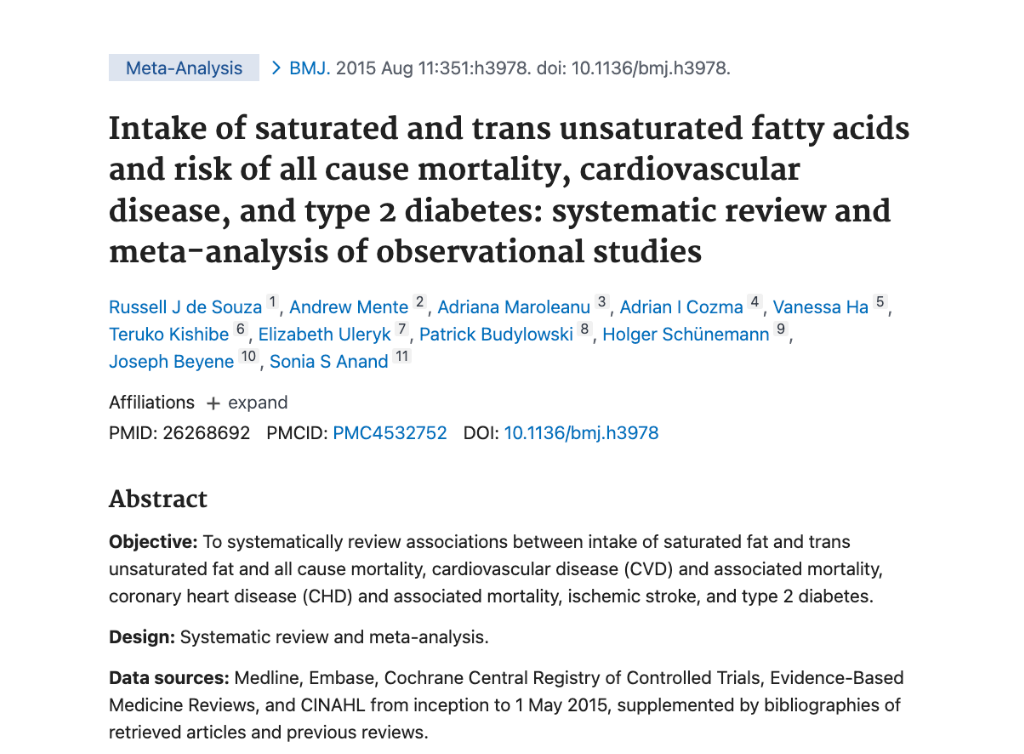
Article Review – Intake of Saturated and Trans Unsaturated Fatty Acids and Risk of All Cause Mortality, Cardiovascular Disease, and Type 2 Diabetes: Systematic Review and Meta-Analysis of Observational Studies

Article Review – Intake of Saturated and Trans Unsaturated Fatty Acids and Risk of All Cause Mortality, Cardiovascular Disease, and Type 2 Diabetes: Systematic Review and Meta-Analysis of Observational Studies

by Russell J de Souza, Andrew Mente, Adriana Maroleanu, Adrian I Cozma, Vanessa Ha, Teruko Kishibe, Elizabeth Uleryk, Patrick Budylowski, Holger Schünemann, Joseph Beyene, Sonia S Anand

This article is part of Opti Metabolics’ ongoing effort to translate complex metabolic research into clear, practical insights for readers without formal scientific or medical training.

Summary -

This large-scale systematic review and meta-analysis evaluated the relationship between dietary intake of saturated and trans fats and major health outcomes including all-cause mortality, cardiovascular disease, coronary heart disease, ischemic stroke, and type 2 diabetes. The findings challenge conventional dietary guidelines by showing that saturated fat intake was not significantly associated with increased health risks, while industrial trans fat intake was consistently linked to negative health outcomes.

Key Takeaways Explained for a Non-Medical Audience

– Saturated fat intake was not significantly associated with increased risk of all-cause mortality, cardiovascular disease, coronary heart disease, ischemic stroke, or type 2 diabetes in observational studies.

– Industrial trans fat intake, particularly from hydrogenated oils, was associated with increased risk of coronary heart disease mortality and events.

– Evidence regarding trans fats from ruminant animal sources (such as dairy and meat) did not show consistent associations with negative health outcomes.

– Several studies included in the analysis lacked rigorous dietary assessment methods, which may influence the interpretation of results.

– The study highlighted the importance of differentiating between natural and industrial trans fats in both research and public health guidance.

– Replacement of saturated fat with refined carbohydrates was not associated with improved health outcomes and may worsen metabolic profiles.

– Recommendations to reduce saturated fat intake without specifying what replaces those calories can lead to increased consumption of high-glycemic, processed carbohydrates.

– Some current dietary guidelines may overstate the health risks of saturated fat without sufficient evidence from high-quality observational data.

– The quality and source of fat matter more than total fat intake; whole-food sources of saturated fats (e.g., dairy, unprocessed meat) may have neutral or beneficial effects.

– Reducing industrial trans fats remains a clear public health priority due to their strong association with cardiovascular disease risk.

– Misleading dietary messaging around saturated fat may have inadvertently promoted higher intake of sugar and refined grains, worsening insulin resistance and metabolic disease.

– Nutrient-dense, minimally processed whole foods should be emphasized rather than isolated macronutrient targets.

– The review called for more research into the metabolic impact of dietary patterns rather than isolated nutrients.

– The findings reinforce the need for evidence-based, context-specific recommendations rather than one-size-fits-all fat restriction.

– Dietary fats should be assessed in terms of overall dietary quality, inflammatory impact, and metabolic consequences, not in isolation.


Integrated Insights –

This review reinforces key Opti Metabolics principles by challenging outdated fat-phobic dietary guidelines and emphasizing the metabolic harms of industrial seed oils and refined carbohydrates. Rather than vilifying saturated fats, the evidence supports a shift toward whole-food, anti-inflammatory dietary patterns that avoid processed fats and sugars.

Alignment with Broader Review Content –

– Industrial trans fats from seed oils contribute to oxidative stress and chronic inflammation, promoting metabolic disease.

– Replacing saturated fats with refined carbohydrates undermines glycemic control and worsens insulin resistance.

– Whole-food sources of saturated fat, especially in ketogenic or low-carb dietary contexts, may support improved lipid profiles and metabolic health.

Reviewed and interpreted by the Opti Metabolics editorial team, with a focus on early metabolic risk detection and prevention.

Read the article to learn more: Intake of Saturated and Trans Unsaturated Fatty Acids and Risk of All Cause Mortality, Cardiovascular Disease, and Type 2 Diabetes: Systematic Review and Meta-Analysis of Observational Studies

Health & Medical Disclaimer –

Opti Metabolics does not provide medical diagnosis, treatment, or advice. Our program is for educational and informational purposes only and does not represent medical advice or the practice of medicine. These article summaries are intended to help readers understand metabolic health research and emerging scientific findings, but personal health decisions should always be made in consultation with a qualified healthcare provider.

Participants are strongly advised to consult their personal healthcare professional before making any dietary, lifestyle, or medication changes.

x
Opti Metabolics provides informational health insights and does not dispense medical advice, diagnose, treat, or cure any medical conditions. Always consult a qualified healthcare professional before making any health-related decisions.

Contact With Us!

Email: info@optimetabolics.com

Join Opti Metabolics

It’s time to take control of your health.

Eat Like a Human Again

Drop your name and email to receive the eBook that shows how returning to simple, whole foods can restore stable energy, support metabolic health, and help your body function the way it was designed to.
Name

The Fast Track to Frailty

Drop your name and email to receive the guide that helps you understand how GLP-1 weight loss changes your body, and why the scale alone never tells the full story.
Name

Starving for Nothing

Drop your name and email to receive the eBook that shows why “Eat Less, Move More” was never your fault. It was the wrong story, and now you get the right one.
Name