Opti Metabolics 11652 Jollyville Road Austin, TX 78759

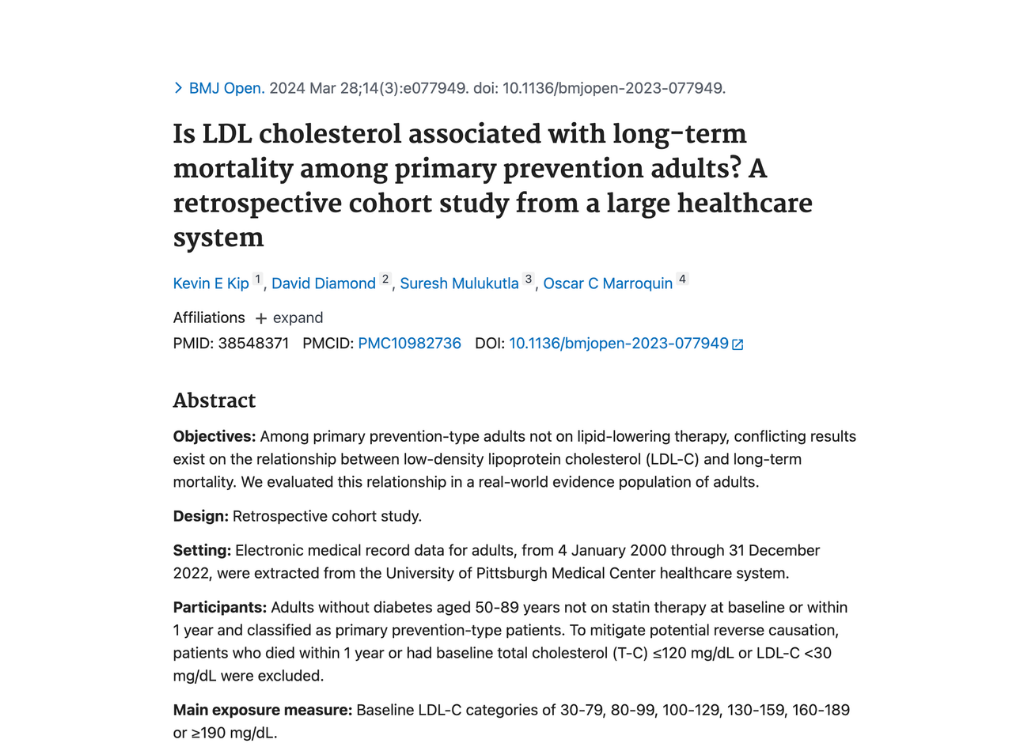
Article Review – Is LDL Cholesterol Associated with Long-Term Mortality Among Primary Prevention Adults? A Retrospective Cohort Study from a Large Healthcare System

Article Review – Is LDL Cholesterol Associated with Long-Term Mortality Among Primary Prevention Adults? A Retrospective Cohort Study from a Large Healthcare System

by Kevin E Kip, David Diamond, Suresh Mulukutla, Oscar C Marroquin

This article is part of Opti Metabolics’ ongoing effort to translate complex metabolic research into clear, practical insights for readers without formal scientific or medical training.

Summary -

This retrospective cohort study reveals a U-shaped association between LDL cholesterol levels and long-term mortality in primary prevention adults aged 50-89 without diabetes and not on statins, with the lowest mortality risk observed in the LDL-C range of 100-189 mg/dL. Contrary to current guidelines emphasizing LDL-C reduction below 100 mg/dL, the findings suggest that very low LDL-C may indicate underlying health issues leading to higher mortality, while moderately elevated levels could be protective when part of a healthy metabolic profile. For metabolic health and prevention, this underscores the need to focus on comprehensive lipid ratios and addressing insulin resistance rather than isolated LDL-C targets, promoting strategies like low-carbohydrate diets to optimize overall energy management and reduce inflammation.

Key Takeaways Explained for a Non-Medical Audience

– The study analyzed 177,860 adults aged 50-89 years without diabetes and not on statin therapy, using data from a large healthcare system spanning 2000-2022.

– Participants were classified as primary prevention-type, excluding those who died within one year or had very low baseline cholesterol to mitigate reverse causation.

– Baseline LDL-C was categorized into six groups: 30-79, 80-99, 100-129, 130-159, 160-189, and ≥190 mg/dL.

– A U-shaped relationship was observed between LDL-C categories and all-cause mortality over a mean follow-up of 6.1 years.

– Crude 10-year mortality rates were 19.8% for LDL-C 30-79 mg/dL, 14.7% for 80-99 mg/dL, 11.7% for 100-129 mg/dL, 10.7% for 130-159 mg/dL, 10.1% for 160-189 mg/dL, and 14.0% for ≥190 mg/dL.

– Using LDL-C 80-99 mg/dL as the referent, adjusted hazard ratios for mortality were 1.23 for 30-79 mg/dL, indicating higher risk.

– Adjusted hazard ratios were 0.87 for 100-129 mg/dL, 0.88 for 130-159 mg/dL, and 0.91 for 160-189 mg/dL, showing lower mortality risk.

– For LDL-C ≥190 mg/dL, the adjusted hazard ratio was 1.19, indicating increased mortality risk.

– The lowest mortality risk was in the broad LDL-C range of 100-189 mg/dL, higher than typical recommendations.

– Unlike LDL-C, total cholesterol to HDL cholesterol ratio and triglycerides to HDL cholesterol ratio were independently associated with long-term mortality.

– Subgroup analyses by age, sex, and baseline ASCVD risk showed consistent U-shaped associations.

– The mean baseline LDL-C was 119 mg/dL, with patients followed starting 365 days after measurement.

– Results challenge prioritizing LDL-C concentration alone for counseling primary prevention patients.

– Minimal consideration should be given to isolated LDL-C levels when assessing long-term risk in this population.

– Findings suggest potential overemphasis on lowering LDL-C below 100 mg/dL in guidelines.

Integrated Insights –

This article aligns with the Opti Metabolics framework by demonstrating that LDL-C levels alone do not dictate mortality risk, emphasizing instead the role of metabolic health markers like lipid ratios that reflect insulin sensitivity and inflammation. In contexts where low-carbohydrate or ketogenic diets may elevate LDL-C within the 100-189 mg/dL range, these findings support such approaches as they can improve overall metabolic function without increasing long-term mortality. By highlighting the dangers of excessively low LDL-C, possibly linked to poor nutrition or chronic stress, the study reinforces using natural, low-carb strategies to address root causes like insulin resistance and oxidative stress.

Alignment with Broader Review Content –

– Complements evidence that insulin resistance, often from high carbohydrate intake, underlies cardiovascular risks more than isolated LDL-C elevations.

– Supports avoiding omega-6-rich seed oils that promote inflammation, as broader lipid profiles like triglyceride/HDL ratios better predict outcomes.

– Aligns with promoting ketogenic or low-carb diets to optimize metabolic health, potentially allowing higher LDL-C without harm in metabolically stable individuals.

Reviewed and interpreted by the Opti Metabolics editorial team, with a focus on early metabolic risk detection and prevention.

Read the article to learn more: Is LDL Cholesterol Associated with Long-Term Mortality Among Primary Prevention Adults? A Retrospective Cohort Study from a Large Healthcare System

Health & Medical Disclaimer –

Opti Metabolics does not provide medical diagnosis, treatment, or advice. Our program is for educational and informational purposes only and does not represent medical advice or the practice of medicine. These article summaries are intended to help readers understand metabolic health research and emerging scientific findings, but personal health decisions should always be made in consultation with a qualified healthcare provider.

Participants are strongly advised to consult their personal healthcare professional before making any dietary, lifestyle, or medication changes.

x
Opti Metabolics provides informational health insights and does not dispense medical advice, diagnose, treat, or cure any medical conditions. Always consult a qualified healthcare professional before making any health-related decisions.

Contact With Us!

Email: info@optimetabolics.com

Metabolic Snapshot Assessment

Metabolic Snapshot Assessment

Prepared for

Metabolic Marty

Assessment Date

June 2,2026

Identifying Metabolic Risk Before It Becomes Disease

Executive Summary

Your results suggest early signs of metabolic dysfunction are emerging beneath the surface.

While you may feel healthy today, several biomarkers indicate increasing risk for insulin resistance, cardiovascular disease, and other chronic conditions if these patterns continue to progress.

The encouraging news is that these findings were identified before disease developed, creating an opportunity to improve your long-term health trajectory through targeted interventions.

Metabolic Age

20

Metabolic Age

your age

60

Metabolic Age

Years
+ 2 .0

Older than your chronological age

Biomarker risk distrubution

No
Risk

31

Low
Risk

22

Medium Risk

9

High Risk

9

Higher Risk

10

Higher numbers indicate more biomarkers in each risk category.

Your Top Priority areas

See What's Driving Your Risk
Understand how your biomarkers and habits are shaping your future health.
See What's Driving Your Risk
Understand how your biomarkers and habits are shaping your future health.
See What's Driving Your Risk
Understand how your biomarkers and habits are shaping your future health.

The Optic Metabolic Lens

We look upstream to identify and address the root drivers of chronic disease long before symptoms appear.

1. Insulin Resistance

Excess insulin and poor cellular response drive metabolic dycfuntion and fat storage.

2. Oxidative stress

Imbalance between free radicals and your body's antioxidant defenses.

3. Inflamation

Chronic, low grade inflamation damages tissues and disrupts normal function.

4. Stress Physiology

Elevated cortisol and other stress hormones amplify the damaga and impair recovery.

5. Genetic Risk

Inherited factors can increase succeptbility and influence how your body responds.

6. Disease Progression

Over time, these drivers create the foundation for chronic disease to take root.

Eat Like a Human Again

Drop your name and email to receive the eBook that shows how returning to simple, whole foods can restore stable energy, support metabolic health, and help your body function the way it was designed to.
Name

The Fast Track to Frailty

Drop your name and email to receive the guide that helps you understand how GLP-1 weight loss changes your body, and why the scale alone never tells the full story.
Name

Starving for Nothing

Drop your name and email to receive the eBook that shows why “Eat Less, Move More” was never your fault. It was the wrong story, and now you get the right one.
Name