Opti Metabolics 11652 Jollyville Road Austin, TX 78759

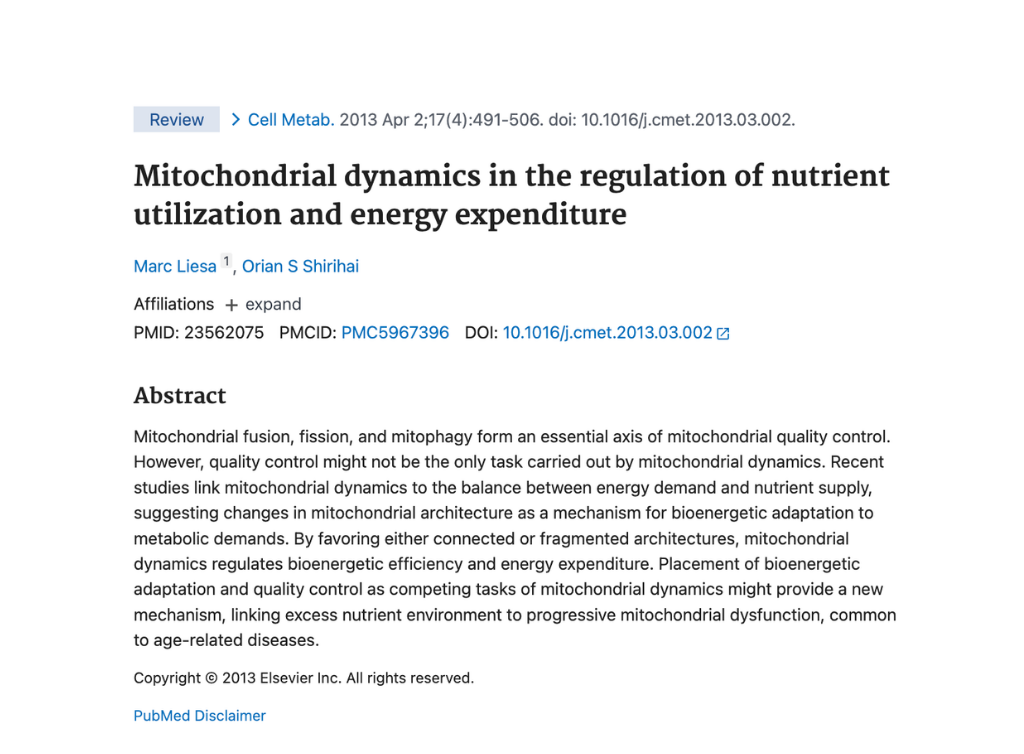
Article Review – Mitochondrial Dynamics in the Regulation of Nutrient Utilization and Energy Expenditure

Article Review – Mitochondrial Dynamics in the Regulation of Nutrient Utilization and Energy Expenditure

by Marc Liesa, Orian S Shirihai

This article is part of Opti Metabolics’ ongoing effort to translate complex metabolic research into clear, practical insights for readers without formal scientific or medical training.

Summary -

The article explores how mitochondrial dynamics, including fusion, fission, and mitophagy, extend beyond quality control to regulate bioenergetic efficiency by adapting mitochondrial architecture to nutrient availability, with fragmented structures in excess nutrient environments reducing ATP production efficiency to mitigate oxidative stress and heat waste. This adaptive mechanism, while protective short-term, may conflict with long-term quality control, leading to progressive mitochondrial dysfunction implicated in metabolic disorders such as obesity and diabetes. Implications for metabolic health emphasize the need for dietary strategies that balance nutrient supply and demand to preserve mitochondrial function and prevent chronic conditions driven by insulin resistance and inflammation.

Key Takeaways Explained for a Non-Medical Audience

– Mitochondrial fusion, fission, and mitophagy form an essential axis for mitochondrial quality control.

– Recent studies link mitochondrial dynamics to balancing energy demand and nutrient supply.

– Changes in mitochondrial architecture, from connected to fragmented, influence bioenergetic efficiency and energy expenditure.

– Under nutrient excess, decreased bioenergetic efficiency generates heat to reduce reactive oxygen species and cytotoxic metabolites.

– In brown adipose tissue, uncoupling protein 1 dissipates the proton gradient for thermogenesis via fatty acid oxidation.

– High-fat diets in rodents increase brown adipose tissue mass and uncoupling protein 1 expression, contributing to diet-induced thermogenesis.

– Nutrient overload activates mechanisms like proton leak to “waste” excess nutrients as heat, potentially preventing triacylglyceride storage in obesity.

– Starvation enhances ATP synthesis capacity through mechanisms like ATP synthase dimerization.

– Optimal ATP production occurs at intermediate mitochondrial membrane potentials around 140 mV.

– Proton leak in non-phosphorylating respiration increases reactive oxygen species production, while uncoupling reduces it.

– Tissues such as beta cells, muscle, and brown adipose respond differently to nutrient availability in terms of bioenergetic adaptations.

– Nutrient utilization pathways, including glycolysis and fatty acid oxidation, have moderate flux control in cellular respiration.

– Excess nutrient environments may interfere with mitochondrial quality control, linking to age-related and metabolic diseases.

– Mitochondrial fragmentation adapts to nutrient excess by arresting fusion, suggesting a conflict with quality maintenance.

– Bioenergetic adaptations in mitochondria could inform treatments for diabetes and obesity by modulating energy expenditure.


Integrated Insights –

This article aligns with the Opti Metabolics framework by highlighting how mitochondrial dynamics optimize nutrient utilization under varying energy demands, supporting low-carbohydrate or ketogenic approaches that limit nutrient excess to enhance bioenergetic efficiency and reduce insulin resistance. By promoting mitochondrial health through balanced nutrient supply, these principles mitigate oxidative stress and inflammation, key contributors to metabolic dysfunction. Overall, it reinforces the idea that dietary interventions can restore mitochondrial adaptability, improving energy expenditure and preventing chronic conditions.

Alignment with Broader Review Content –

– Connects mitochondrial dysfunction from nutrient excess to insulin resistance, aligning with views on excessive carbohydrate consumption impairing blood sugar management.

– Emphasizes the role of inflammation and oxidative stress in metabolic diseases, consistent with concerns over omega-6-rich seed oils exacerbating these issues.

– Supports mitigation through natural, low-carbohydrate diets that enhance mitochondrial efficiency, mirroring strategies to address underlying metabolic stressors.

Reviewed and interpreted by the Opti Metabolics editorial team, with a focus on early metabolic risk detection and prevention.

Read the article to learn more: Mitochondrial Dynamics in the Regulation of Nutrient Utilization and Energy Expenditure

Health & Medical Disclaimer –

Opti Metabolics does not provide medical diagnosis, treatment, or advice. Our program is for educational and informational purposes only and does not represent medical advice or the practice of medicine. These article summaries are intended to help readers understand metabolic health research and emerging scientific findings, but personal health decisions should always be made in consultation with a qualified healthcare provider.

Participants are strongly advised to consult their personal healthcare professional before making any dietary, lifestyle, or medication changes.

x
Opti Metabolics provides informational health insights and does not dispense medical advice, diagnose, treat, or cure any medical conditions. Always consult a qualified healthcare professional before making any health-related decisions.

Contact With Us!

Email: info@optimetabolics.com

Join Opti Metabolics

It’s time to take control of your health.

Eat Like a Human Again

Drop your name and email to receive the eBook that shows how returning to simple, whole foods can restore stable energy, support metabolic health, and help your body function the way it was designed to.
Name

The Fast Track to Frailty

Drop your name and email to receive the guide that helps you understand how GLP-1 weight loss changes your body, and why the scale alone never tells the full story.
Name

Starving for Nothing

Drop your name and email to receive the eBook that shows why “Eat Less, Move More” was never your fault. It was the wrong story, and now you get the right one.
Name