Opti Metabolics 11652 Jollyville Road Austin, TX 78759

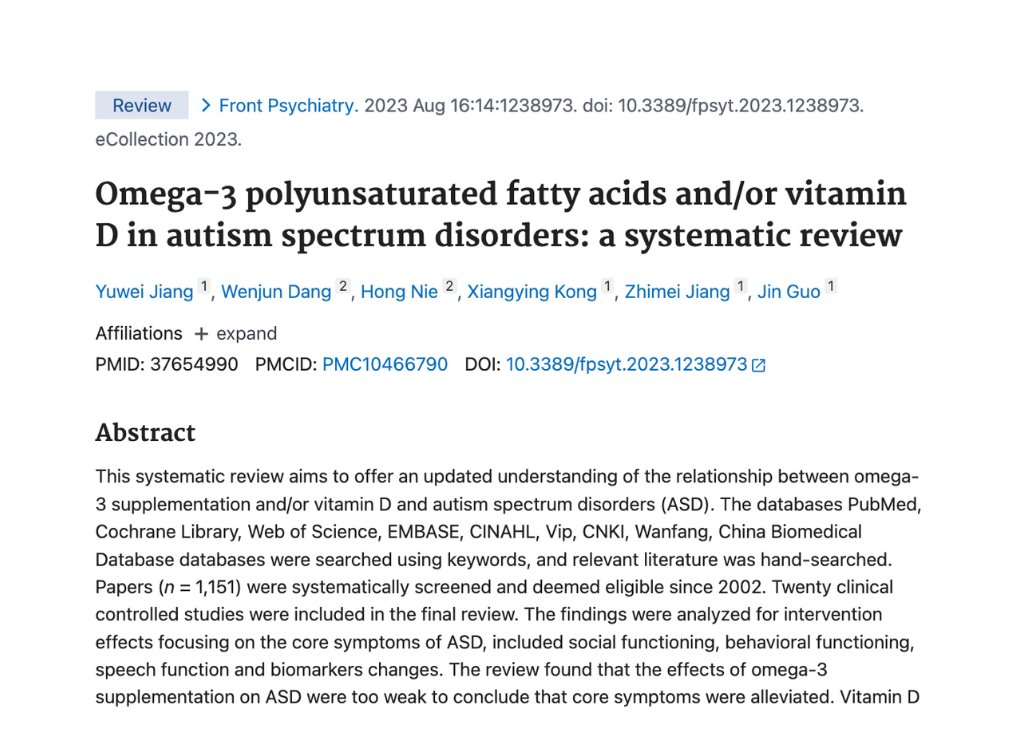
Article Review – Omega-3 Polyunsaturated Fatty Acids and/or Vitamin D in Autism Spectrum Disorders: A Systematic Review

Article Review – Omega-3 Polyunsaturated Fatty Acids and/or Vitamin D in Autism Spectrum Disorders: A Systematic Review

by Yuwei Jiang, Wenjun Dang, Hong Nie, Xiangying Kong, Zhimei Jiang, Jin Guo

This article is part of Opti Metabolics’ ongoing effort to translate complex metabolic research into clear, practical insights for readers without formal scientific or medical training.

Summary -

This systematic review explores the therapeutic potential of omega-3 fatty acids and vitamin D supplementation in individuals with autism spectrum disorder (ASD), focusing on their ability to alleviate behavioral symptoms and improve neurodevelopmental outcomes. The findings suggest that these nutrients may exert anti-inflammatory, neuroprotective, and modulatory effects on brain function, especially where metabolic and immune dysfunctions may be contributing factors.

Key Takeaways Explained for a Non-Medical Audience

– Omega-3 fatty acids and vitamin D are often deficient in individuals with ASD, potentially worsening symptoms.

– Several included studies showed that omega-3 supplementation helped reduce hyperactivity, lethargy, and stereotypy in ASD patients.

– Vitamin D plays a role in neurodevelopment, neurotransmitter synthesis, and immune regulation, all of which are relevant in ASD pathology.

– Anti-inflammatory properties of omega-3s may help mitigate neuroinflammation associated with ASD.

– Some trials showed improved social responsiveness and communication skills with omega-3 and/or vitamin D supplementation.

– The combination of omega-3s and vitamin D may have synergistic benefits due to overlapping mechanisms.

– Variability in dosage, duration, and patient response across studies underscores the need for individualized treatment.

– Low baseline vitamin D levels were associated with more severe ASD symptoms, suggesting potential for targeted intervention.

– Omega-3s, particularly EPA and DHA, support neuronal membrane integrity and signaling, critical for cognitive and behavioral function.

– Supplementation was generally well-tolerated with minimal adverse effects reported.

– Improvements were more significant in children with higher baseline inflammation markers or immune dysregulation.

– Multiple mechanisms—including reduced oxidative stress, cytokine modulation, and improved serotonin regulation—may explain observed benefits.

– Researchers noted the need for larger, better-controlled trials to confirm efficacy and establish optimal protocols.

– Some studies failed to show significant improvements, likely due to short duration or low dosing.

– Addressing metabolic and nutritional imbalances may be a valuable adjunct to behavioral therapy in ASD.


Integrated Insights –

This review aligns with the Opti Metabolics framework by highlighting how systemic inflammation, oxidative stress, and metabolic imbalances—including fatty acid and micronutrient deficiencies—can influence neurodevelopmental health. It reinforces the therapeutic value of natural, bioavailable nutrients in modulating inflammation and promoting metabolic stability.

Alignment with Broader Review Content –

– Reinforces the anti-inflammatory role of omega-3 fatty acids and vitamin D in managing chronic or neurobehavioral conditions.

– Demonstrates that nutrient optimization may counteract the metabolic and immune dysfunctions often seen in modern inflammatory diseases.

– Supports the principle that individualized, nutrient-dense, low-inflammatory strategies can be more effective than symptom-based interventions alone.

Reviewed and interpreted by the Opti Metabolics editorial team, with a focus on early metabolic risk detection and prevention.

Read the article to learn more: Omega-3 Polyunsaturated Fatty Acids and/or Vitamin D in Autism Spectrum Disorders: A Systematic Review

Health & Medical Disclaimer –

Opti Metabolics does not provide medical diagnosis, treatment, or advice. Our program is for educational and informational purposes only and does not represent medical advice or the practice of medicine. These article summaries are intended to help readers understand metabolic health research and emerging scientific findings, but personal health decisions should always be made in consultation with a qualified healthcare provider.

Participants are strongly advised to consult their personal healthcare professional before making any dietary, lifestyle, or medication changes.

x
Opti Metabolics provides informational health insights and does not dispense medical advice, diagnose, treat, or cure any medical conditions. Always consult a qualified healthcare professional before making any health-related decisions.

Contact With Us!

Email: info@optimetabolics.com

Join Opti Metabolics

It’s time to take control of your health.

Eat Like a Human Again

Drop your name and email to receive the eBook that shows how returning to simple, whole foods can restore stable energy, support metabolic health, and help your body function the way it was designed to.
Name

The Fast Track to Frailty

Drop your name and email to receive the guide that helps you understand how GLP-1 weight loss changes your body, and why the scale alone never tells the full story.
Name

Starving for Nothing

Drop your name and email to receive the eBook that shows why “Eat Less, Move More” was never your fault. It was the wrong story, and now you get the right one.
Name