Email: success@optimetabolics.com
This article is part of Opti Metabolics’ ongoing effort to translate complex metabolic research into clear, practical insights for readers without formal scientific or medical training.
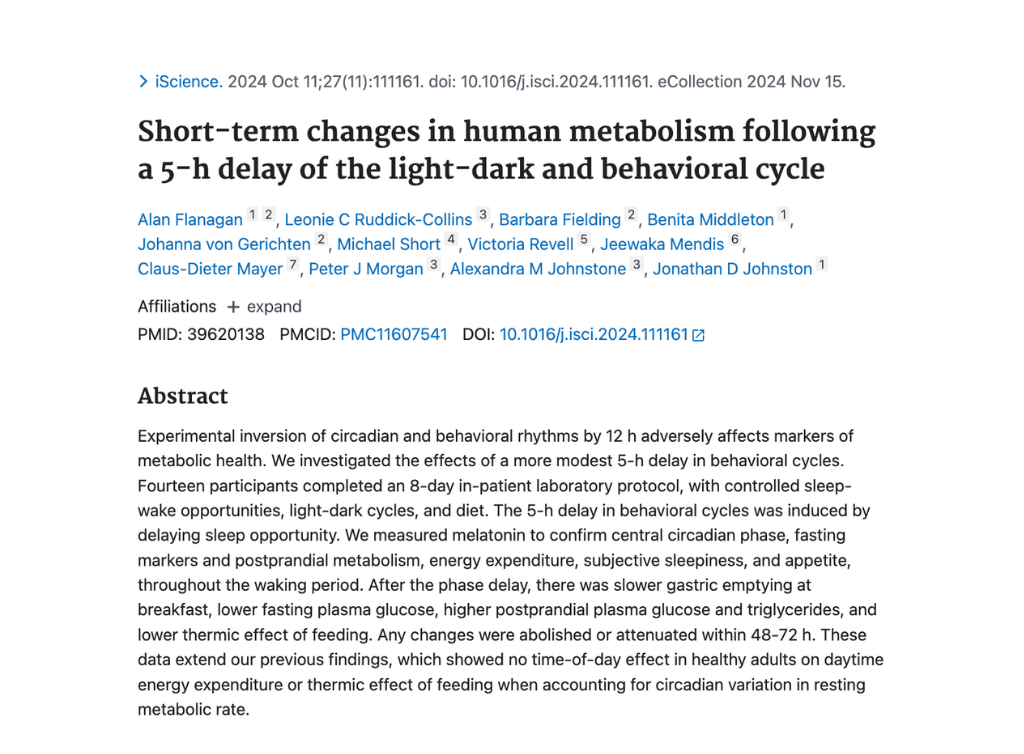
This study explored the metabolic effects of a 5-hour delay in the light-dark and behavioral cycle—essentially mimicking a shift in circadian rhythm—on healthy adults over a short period. Even a modest disruption of circadian alignment led to impaired glucose tolerance and changes in lipid metabolism, underscoring the metabolic risks of circadian misalignment commonly seen in modern lifestyles.
– A 5-hour delay in sleep, eating, and light exposure significantly altered glucose metabolism within just a few days.
– Postprandial glucose levels were elevated following the circadian shift, indicating reduced glucose tolerance.
– Insulin response increased, suggesting a transient decrease in insulin sensitivity.
– Fasting triglyceride levels were modestly increased, hinting at early dysregulation in lipid metabolism.
– The timing of food intake relative to internal circadian rhythms had a measurable impact on metabolic outcomes.
– Participants showed a delayed phase in melatonin secretion, confirming circadian disruption.
– The circadian delay impaired substrate oxidation patterns, suggesting inefficiencies in energy utilization.
– There were measurable changes in respiratory quotient, indicating a shift in fuel preference away from fat oxidation.
– These effects occurred despite no changes in calorie intake, physical activity, or macronutrient composition.
– Disruption of the light-dark cycle influenced hormonal rhythms involved in metabolic regulation.
– The altered metabolic state was reversible but points to cumulative risk if such misalignment is chronic.
– Results suggest that even short-term circadian disruption could contribute to long-term metabolic disease risk.
– The study reinforces the importance of behavioral timing—including meal timing—on metabolic regulation.
– Findings may help explain why shift workers and those with irregular sleep-wake cycles are at higher risk for obesity, insulin resistance, and cardiometabolic disease.
– These disruptions may operate independently of dietary composition, highlighting the role of circadian alignment in metabolic health.
This study supports the Opti Metabolics view that circadian rhythm alignment is a fundamental, often overlooked factor in metabolic health. Even without dietary changes, disruptions to behavioral timing can impair glucose and lipid regulation, compounding the effects of insulin resistance.
– Highlights that insulin resistance and metabolic dysfunction can be triggered or worsened by poor circadian alignment.
– Supports the principle that the timing of food and light exposure matters as much as dietary composition in metabolic control.
– Reinforces the Opti Metabolics approach of integrating behavioral rhythms—especially sleep and meal timing—into strategies for reversing metabolic disease.
Reviewed and interpreted by the Opti Metabolics editorial team, with a focus on early metabolic risk detection and prevention.
Read the article to learn more: Short-Term Changes in Human Metabolism Following a 5-h Delay of the Light-Dark and Behavioral Cycle
Opti Metabolics does not provide medical diagnosis, treatment, or advice. Our program is for educational and informational purposes only and does not represent medical advice or the practice of medicine. These article summaries are intended to help readers understand metabolic health research and emerging scientific findings, but personal health decisions should always be made in consultation with a qualified healthcare provider.
Participants are strongly advised to consult their personal healthcare professional before making any dietary, lifestyle, or medication changes.
Email: info@optimetabolics.com
Your results suggest early signs of metabolic dysfunction are emerging beneath the surface.
While you may feel healthy today, several biomarkers indicate increasing risk for insulin resistance, cardiovascular disease, and other chronic conditions if these patterns continue to progress.
The encouraging news is that these findings were identified before disease developed, creating an opportunity to improve your long-term health trajectory through targeted interventions.
No
Risk
Low
Risk
Medium Risk
High Risk
Higher Risk
Higher numbers indicate more biomarkers in each risk category.
We look upstream to identify and address the root drivers of chronic disease long before symptoms appear.
Excess insulin and poor cellular response drive metabolic dycfuntion and fat storage.
Imbalance between free radicals and your body's antioxidant defenses.
Chronic, low grade inflamation damages tissues and disrupts normal function.
Elevated cortisol and other stress hormones amplify the damaga and impair recovery.
Inherited factors can increase succeptbility and influence how your body responds.
Over time, these drivers create the foundation for chronic disease to take root.